

IPTV Reseller Support System That Scales in 2026

An IPTV Reseller Support System is the combination of tiers, escalation rules and reusable resources that decides how fast a customer actually gets an answer, not how confident the sales page sounds. Most resellers start with one WhatsApp number and answer everything themselves. That works fine at twenty customers. It falls apart at two hundred, because the same reseller is now typing out the same buffering explanation for the fortieth time while a payment query from a sub reseller sits unread for six hours.
The panels that keep customers past their first renewal are rarely the ones with the most channels or the cheapest credits. They are the ones where a question gets answered before the customer starts looking elsewhere.
Building an IPTV Reseller Support System That Doesn’t Collapse Under Growth
A support setup that survives growth needs three things a single inbox never provides: a way to sort incoming messages by what they actually need, a rule for when something gets passed up rather than handled at the first point of contact, and written answers that don’t have to be rebuilt from scratch every time. None of this requires a large team. A one person operation can run all three with basic discipline. What breaks resellers isn’t the size of their customer base, it’s trying to hold every rule and every answer in their own head instead of writing it down once.
The panel side of this matters too. If your dashboard doesn’t show you which customer is asking about what, or when their credit last renewed, you’re troubleshooting blind every single time. IPTV reseller panels built with clear credit tracking remove a fair amount of that guesswork before a support conversation even starts.
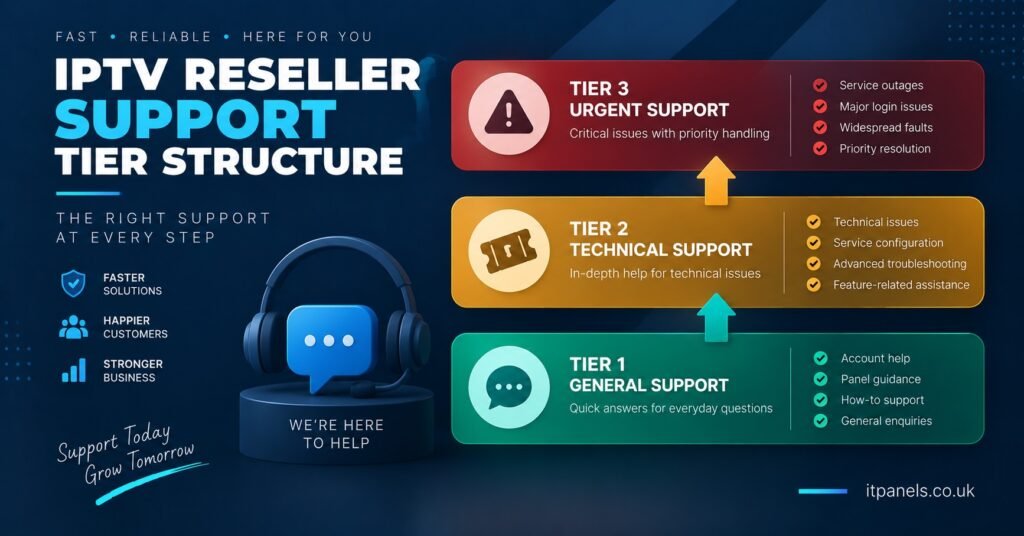
The Support Tiers Most Small Panels Skip
Splitting support into tiers sounds like something only larger operations need. In practice it’s the difference between a five minute reply and a customer waiting overnight because their message got buried under three unrelated ones.
| Tier | What It Handles | Typical Response Window |
|---|---|---|
| Tier 1 | Buffering, app login, device setup, renewal reminders | Under 30 minutes |
| Tier 2 | Credit disputes, account transfers, device limit issues | 1 to 4 hours |
| Tier 3 | Server outages, panel access faults, sub reseller escalations | Immediate, treated as priority |
Tier 1 covers the bulk of what actually arrives, usually between seventy and eighty percent of daily messages in most reseller operations. It’s repetitive, but it’s also the fastest to answer well once you have the wording ready. Tier 2 needs someone who can actually see account history rather than just the panel’s front end. Tier 3 is where a reseller’s own judgement matters most, because a server issue affecting one household looks identical to one affecting fifty until someone checks.
When a Ticket Should Move Up a Tier
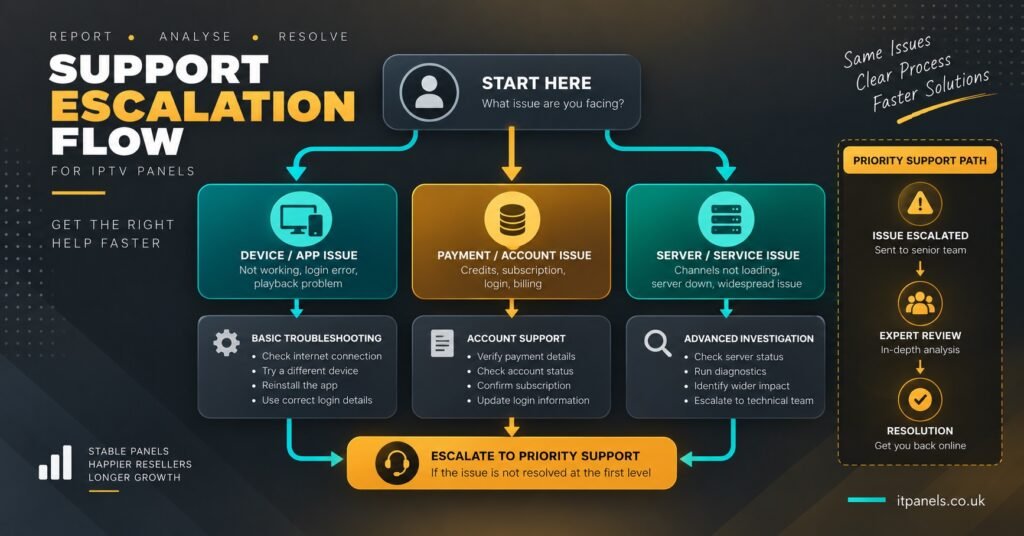
Escalation only works if there’s a rule attached to it, not a feeling. Vague instructions like “if it seems serious” lead to some issues sitting untouched for a day while others get forwarded unnecessarily.
A workable rule set looks closer to this: any message mentioning multiple households or multiple devices affected at once moves straight to Tier 3, skipping the queue. Anything involving money, refunds, disputed charges or credit balances moves to Tier 2 automatically, since guessing at a credit dispute without account access usually makes it worse. Everything else starts at Tier 1, and if it can’t be resolved within the stated window, it moves up rather than sitting open.
Pro tip: Keep a short internal note on every escalated ticket explaining why it moved up. It takes ten seconds and saves the next person from re-reading the whole conversation to work out what’s already been tried.
Reusable Resources That Cut Response Time Without Adding Staff
The single biggest time saver in any IPTV reseller panel customer onboarding flow, and in ongoing support afterwards, is having answers written once and reused. Not scripted robotic replies, but a small library covering the questions that come up daily: app not loading, EPG missing, device swap requests, how credits work, what to do before assuming a fault is on the provider’s side.
A macro library doesn’t need to be complicated. A simple document split by category, with two or three phrasing variations per issue so replies don’t read as copy pasted, covers most of what a growing panel needs. Pair that with a short internal fault tree, checking the app, then the device, then the network, then the server, before anything gets escalated, and a lot of Tier 1 traffic resolves itself in the first reply instead of a back and forth that eats the whole evening.
Where Support Systems Quietly Break Down
Most support setups don’t fail loudly. They fail one small habit at a time. A reseller stops logging which issues repeat, so the same fault gets diagnosed from scratch every time it appears. Escalation rules exist on paper but get ignored under pressure, so urgent tickets sit behind routine ones. Sub resellers get no visibility into which tier their own customers’ issues sit at, so they end up forwarding everything to the parent panel regardless of severity, which defeats the point of having tiers at all.
The other common failure is treating support as something separate from the renewal timing built into a reseller’s customer relationships. A customer whose support ticket gets ignored for two days is far less likely to renew, regardless of how reliable the underlying service actually is. Support quality and renewal rate are the same metric viewed from two angles.
Sub Reseller Support: Who Answers What
Where a panel sells to sub resellers, support needs a clear ownership line or every issue turns into confusion about whose responsibility it actually is. The sub reseller should own Tier 1 for their own customers, since they know that customer relationship directly. The parent panel should own anything involving the underlying server, credit stock, or infrastructure, since the sub reseller has no visibility into that layer.
Where this breaks down is when a sub reseller forwards every message upward without attempting Tier 1 first, or when a parent panel refuses to help with anything beyond the credit sale itself. Neither extreme works long term. A short written agreement covering exactly which issues sit where, and this ties directly back into how account records and expiry tracking get kept in an IPTV reseller CRM, removes most of that ambiguity before it turns into a dispute.
Pro tip: Give sub resellers a copy of your Tier 1 macro library. It’s a small thing to hand over, and it means fewer half answered tickets reaching your own inbox.
Frequently Asked Questions
How many support tiers does a small reseller actually need?
Three is usually enough for a panel with under a few hundred customers. Fewer than that and urgent issues get mixed in with routine ones. More than that and the handoffs themselves start slowing things down.
Should response time targets be advertised to customers?
A rough range, such as replies within the hour during active hours, is reasonable to state. Promising instant responses around the clock tends to backfire the first time it isn’t met.
What’s the fastest way to reduce repeat support tickets?
Track which issues come up more than twice in a week and fix the root cause, whether that’s an unclear onboarding step or a device compatibility gap, rather than answering the same question each time it resurfaces.
Do sub resellers need their own separate support system?
Not a separate system exactly, but they do need clear ownership of Tier 1 for their own customers and access to the same macro resources the parent panel uses.
Is outsourced support worth it for a small IPTV panel?
Usually not until Tier 1 volume becomes genuinely unmanageable alone, since outsourced staff without account access can only handle the simplest queries and everything else still lands back with the reseller.
An IPTV Reseller Panel Support System doesn’t need to be elaborate to work. It needs tiers that match how issues actually arrive, an escalation rule that doesn’t depend on guesswork, and a set of written answers that get reused instead of retyped. Start with the macro library and the three tier split described above, since those two changes alone remove most of the daily friction. Everything else, from sub reseller agreements to fault trees, can be added once the basics are actually holding up under real traffic rather than built in advance for a customer base that doesn’t exist yet.
Reseller Support Checklist
- Split incoming messages into at least three tiers before responding to any of them
- Write escalation rules down rather than relying on judgement in the moment
- Build a macro library for the ten most repeated support questions
- Log recurring issues weekly and fix root causes instead of re-answering them
- Give sub resellers Tier 1 ownership plus access to shared macros
- Review response times monthly against the windows you’ve actually set

[…] entries also show which IPTV reseller or sub-reseller account generated the line. On a panel running sub-resellers, this is often the […]