

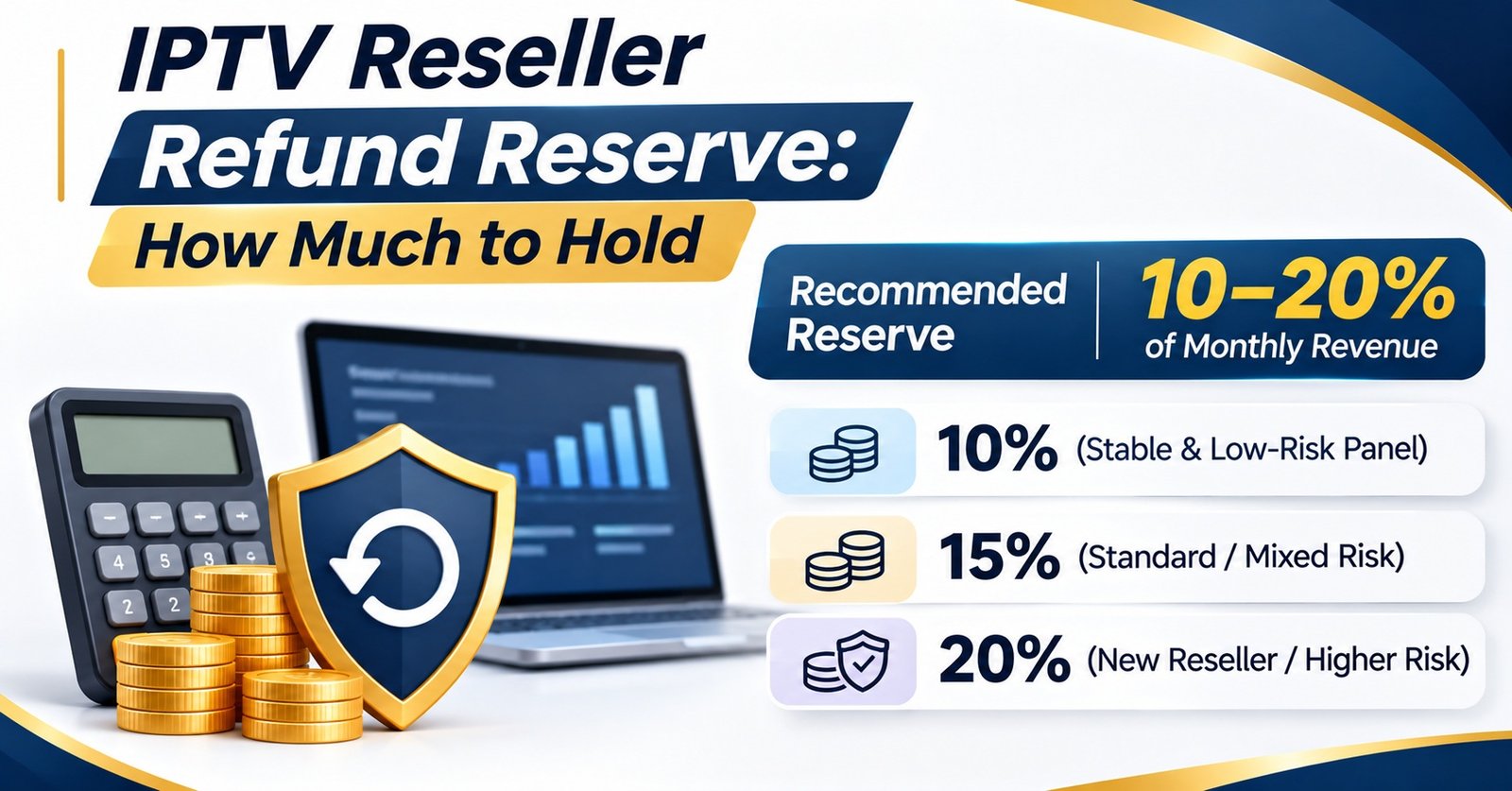
IPTV Reseller Refund Reserve: How Much Cash to Hold 2026

An IPTV Reseller Refund Reserve is a pot of real cash you set aside for one job: paying customers back when you owe them money. That covers refunds you’ve agreed to, partial refunds after a service problem, and card chargebacks. A sensible starting size is your average monthly refunds plus a buffer, your chargeback exposure on recent card sales, and enough to cover the single worst incident you can realistically picture. For a small IPTV reseller, that usually works out to a few hundred pounds held separately, not mixed in with trading money and certainly not “held” as unused panel credits.
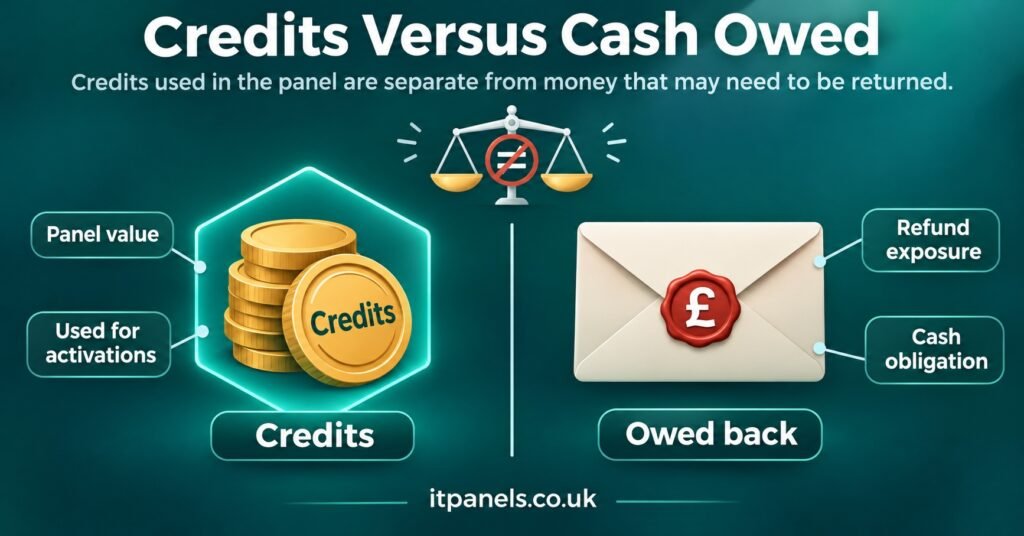
The mistake that catches people out is looking at the reseller dashboard, seeing a healthy credit balance and assuming they’re covered. They aren’t. Credits let you create or extend subscriptions, but a customer asking for money back wants pounds in their bank account, and most providers don’t turn credits back into cash. If you keep that difference clear, almost every other decision about the reserve gets easier, because you stop counting the same asset twice.
[ez-toc]
Two Numbers That Look Alike on a Dashboard
A credit balance and a refund obligation can both be shown in pounds, and that’s why they get confused. They are different kinds of thing.
Your credit balance is stock. You bought it in advance from your provider, and you can spend it in one way only: on activations, renewals and extensions inside the panel. Its value depends on you selling it. If your provider’s terms say purchased credits are non-refundable, and many do, then the cash you could get back from that balance today is close to nothing, whatever it cost you.
A refund obligation is a debt. It exists the moment you agree to give money back, or the moment a customer becomes entitled to it under your own refund policy. You pay it in cash, it often has a deadline attached, and you can’t pay it in credits unless the customer agrees to take a fix or an extension instead.
So there are two questions, and they need separate answers:
- How many credits do I need? This is stock planning. It’s driven by sales velocity and supplier lead time, which is what the guide on timing your credit top-ups around reorder points is built around.
- How much cash might I owe back? This is the reserve. It’s driven by your refund terms, your payment methods and your exposure to things going wrong upstream.
There’s one useful overlap. When a customer accepts a free extension instead of a refund, you’ve swapped a cash obligation for a credit cost. That’s often the better outcome for both sides, but it only works if the customer agrees. A reserve plan that assumes everyone will take credit instead of cash isn’t really a reserve.
Sizing an IPTV Reseller Refund Reserve From Your Own Sales
You don’t need a sector-wide percentage to size this, and you shouldn’t trust one if you find it. Your refund rate depends on your customers, your setup support, the devices people use and how clearly you sell. Use your own history, even if it only goes back three months.
Build the reserve in three layers.
Layer one: routine refunds. Add up what you actually refunded over the last three to six months, take the monthly average and multiply it by 1.5. The extra half covers a bad month without you having to raid other money.
Layer two: chargeback exposure. Card disputes can arrive weeks or months after the sale, so look back further. Take your card and wallet sales over the last 90 days, apply your own dispute rate, and add your payment processor’s dispute fee for each expected case. If you’ve never had a chargeback, still hold something here. A first-time cluster is exactly the event you can’t predict from zero history.
Layer three: the single worst plausible incident. This is the one people skip. Ask what would happen if your provider had a multi-day disruption and a slice of your customers wanted money back for the time they’d lost. Estimate how many customers and the average pro-rata amount for each, and hold that.
Here’s a worked hypothetical so the arithmetic is visible. The figures are illustrative, not a benchmark.
A UK IPTV reseller takes about £3,000 a month in subscription sales, with roughly 150 active customers. Over the last four months, refunds averaged £120 a month. About 60% of sales are card payments, so card sales over 90 days come to roughly £5,400, and the seller’s dispute rate has been about 1%. For the worst case, the seller estimates that around 30 customers might ask for a partial refund averaging £15 after a serious outage.
- Layer one: £120 × 1.5 = £180
- Layer two: £5,400 × 1% = £54, plus fees on roughly one dispute
- Layer three: 30 × £15 = £450
That’s about £690 before fees. Rounding up to £700 is perfectly reasonable. Notice that layer three is the biggest number, and it’s the one a quick glance at last month’s refunds would never show you.
If you want to see how the reserve fits into your overall cost base, it’s worth reading it alongside a break-even calculation for credit bundles. Money tied up in a reserve isn’t lost, but it isn’t available for buying stock either, and break-even timing should reflect that.
Four Cash Scenarios and What Each One Drains
A reserve number on its own doesn’t tell you much. What matters is how it behaves under pressure. The four scenarios below use the same hypothetical seller with a £700 reserve.
A quiet, ordinary month
Three customers cancel inside the refund window. One couldn’t get their device working, one bought the wrong term and one simply changed their mind. Refunds total £105.
The reserve absorbs it easily. The important habit is refilling it from the next week’s takings before treating any of that income as profit. Small, regular drawdowns that never get replaced are how reserves quietly reach zero.
A provider disruption lasting several days
Service is patchy for four days and support tickets pile up. Thirty customers get in touch. Twenty accept a free week’s extension, which costs credits from your stock rather than cash. Ten want money back, averaging £15 each.
Cash out: £150, plus whatever credits the extensions use. This is the scenario where the credit/cash split shows up most clearly. Offering an extension first is reasonable, but the customer chooses, and you need the cash ready for those who say no. Check your own refund policy wording so your staff offer the same terms every time.
A cluster of chargebacks
Five card payments of £40 are disputed within a fortnight. Some may be friendly fraud, and some may come from customers who never reached support. Each dispute also carries a processor fee, and some processors will hold back part of your payout while disputes are open.
Cash out: £200 plus fees, and potentially a temporarily frozen balance on top. This is why the reserve shouldn’t sit in your payment processor account. If that balance gets held, your reserve gets held with it.
Your upstream provider stops trading
Here’s the uncomfortable one. Sixty customers are on 12-month subscriptions at £60, with an average of six months left. If service ends permanently, the pro-rata value of what they’ve prepaid is roughly £1,800.
A £700 reserve doesn’t cover that, and it isn’t meant to. A refund reserve is for normal and moderately bad events. Full provider failure is a concentration risk, and the defences against it sit elsewhere: limiting how much long-term prepaid revenue you depend on from a single upstream source, and checking that a provider actually has the distribution rights for what it supplies. IPTV is only a delivery technology, so a polished panel or a reliable payment page tells you nothing about licensing. A provider shut down for operating without rights takes your customers’ prepaid time with it.
| Scenario | Cash drawn from reserve | Reserve left |
|---|---|---|
| Quiet month, three refunds | £105 | £595 |
| Several-day disruption, ten cash refunds | £150 | £550 |
| Five chargebacks plus fees | £200 plus fees | Under £500 |
| Provider stops trading | About £1,800 | Shortfall of about £1,100 |
The table shows something the averages hide. The first three events can happen in the same month, and together they’d still leave you solvent. The fourth can’t be fixed by a bigger pot alone.
Where the Money Should Physically Sit
A reserve you can see in your working account is a reserve you’ll eventually spend. Keep it somewhere that adds a small amount of friction.
A separate business savings pot or a second current account works well. It should be in your own name or your company’s, reachable within a day, and not tied to your payment processor. Avoid holding it as credits, as a balance with your provider, or as “money I’ll move later”. Avoid crypto wallets or anything that changes in value, because the obligation is fixed in pounds and the reserve should be too.
Pro tip: Name the account something blunt, such as “Customer refunds only”. It sounds trivial, but it makes the purpose obvious to anyone on your team with banking access, and it makes borrowing from it feel like what it is.
Rules That Stop the Reserve Being Spent on Other Things
Most reserves don’t fail because they were too small. They fail because they were used for something else. A few written rules solve that.
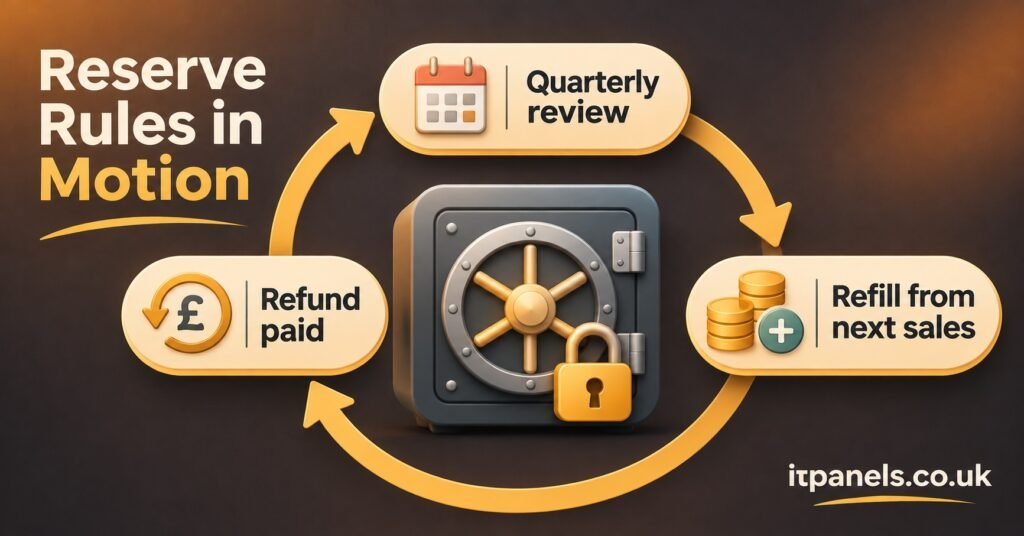
Money leaves the reserve only for an approved refund, a chargeback debit or a processor fee linked to a dispute. It’s never used for buying credits, paying for advertising, covering a slow sales week or paying yourself.
Every withdrawal gets refilled from the next incoming sales, before anything else. If you run sub-resellers under an IPTV panel reseller account, decide in advance who refunds whom. A sub-reseller’s customer usually expects the sub-reseller to pay, but if the parent account takes the payment, the obligation may land with you, so your reserve has to reflect who actually holds the customer’s money.
Review the figure every quarter. Recalculate all three layers from fresh data. If you’ve moved more customers onto longer terms, your exposure has grown even if your monthly refunds haven’t.
This Is Not a Retention Budget
It’s easy to let the reserve drift into a general “keep customers happy” fund. Resist that.
A free month offered to someone thinking of leaving, a loyalty discount or a goodwill gesture after a minor complaint are all retention choices. They’re marketing decisions, they’re optional, and they’re usually paid in credits or reduced margin. You decide whether to make them.
Refunds and chargebacks aren’t optional. Once you owe the money, you owe it. If retention spending comes out of the same pot, a generous month of discounts leaves you short just when a dispute cluster arrives. Keep a separate retention line in your plans, funded from margin, and judge it on whether it keeps customers. Judge the reserve on one thing only: whether you could pay every legitimate claim this month without stress.
The same thinking applies when you compare suppliers. When you’re weighing reseller credit packs and their terms, look at what the provider does when service fails, not just the price per credit. If upstream compensation comes as credits, it refills your stock. It doesn’t refill your cash reserve, so you’ll still carry those customer refunds yourself.
Questions Sellers Ask About Refund Reserves
Can I count unused credits towards my refund reserve?
No. Unless your provider will turn credits back into cash on request, and in writing, credits are stock rather than money. Count them in your stock plan and keep the reserve in cash.
Should a new IPTV seller with no refund history hold a reserve?
Yes, and possibly a proportionally larger one. With no history, layer one is a guess, so lean on layer three. Picture a realistic bad week and hold enough to refund those customers in full.
Does selling longer subscription terms change the reserve?
It changes your exposure more than your routine refunds. Twelve-month sales bring in cash up front, but they create a longer period in which customers may expect money back if service fails. Many sellers handle this by keeping part of each long-term sale aside until the term is partly used.
Do payment processor reserves replace mine?
No. Some processors keep a rolling hold on your payouts to protect themselves against disputes. That money protects the processor, not you, and it may not be released when you need it. Treat it as a separate cash-flow constraint.
How often should a UK IPTV reseller recalculate the figure?
Quarterly is a sensible rhythm, and also after any change in pricing, term mix, payment methods or provider. A reserve sized for last year’s business can be badly out of step with this year’s.
Getting Your IPTV Reseller Refund Reserve Right This Quarter
An IPTV Reseller Refund Reserve does a narrow job, and that’s exactly why it works. It’s cash, held separately, sized from your own refund and dispute history plus one realistic bad event, and spent on nothing except money you owe back. It won’t save a business whose single upstream provider disappears, and pretending otherwise gives false comfort. Against the ordinary run of cancellations, partial refunds after disruptions and surprise chargebacks, though, it’s the difference between paying calmly and scrambling. Start by pulling your last three months of refunds and card sales, run the three layers, and open the separate account the same day. Treat the figure as provisional and correct it at your next quarterly review.

[…] you want the features and prices in one place before choosing, the full list of reseller panel packs shows every tier together, including what each one […]