


IPTV Reseller Panel Gross Margin: 2026 UK Worked Example

IPTV Reseller Panel Gross Margin is the share of your net subscription revenue left after paying the direct cost of delivering each subscription. That means the credits each line consumes, card processing fees, refunds and disputes, credits lost on renewals that never got paid, and the support time spent activating and keeping customers running. Divide what remains by net revenue and you have your figure. In the UK worked example below, a reseller charging £12 a month on £2 credits looks like an 83% business on the back of an envelope, yet lands at just under 65% once every direct cost is booked.
Those missing 18 points are the reason the calculation earns its place in a monthly routine, particularly once you are past your first few dozen customers. At 20 subscribers, a couple of unpaid renewals and an evening of setup help barely register. At 150, they decide whether a price rise is needed, whether a part-time support assistant pays for themselves, and whether moving up to a bigger credit pack actually changes anything. Keep in mind that gross margin is not profit. Website costs, advertising and tax on profits sit further down the accounts, and keeping them out of this figure is exactly what makes it a clean measure of the core job: selling and servicing subscriptions.
[ez-toc]
What Belongs Above the Line, and What Doesn’t
The formula itself is short:
Gross margin % = (Net revenue − Cost of sales) ÷ Net revenue × 100
The arguments start with the definitions. Net revenue is what customers paid you for subscriptions in the period, minus refunds and chargebacks, and minus VAT if you are VAT-registered. Cost of sales is anything you would not have spent if that subscription had not existed.
| Counts in cost of sales | Stays below gross profit |
|---|---|
| Credits consumed by paid lines | Website, hosting and domain costs |
| Credits consumed by lines that were never paid for | Advertising and promotional spend |
| Card and payment processing fees | Accountancy and software subscriptions |
| Dispute and chargeback fees | Your own time spent on growth and admin |
| Paid player app activations, if charged per device | Corporation tax or income tax on profits |
| Support time spent on activations, renewals and fixes | Credits sitting unused in your panel |
The last row on the right trips up a lot of resellers. Credits you have bought but not yet used are stock, not a cost. Buying a 120-credit pack for £240 in March does not make March a bad month. The cost lands in whichever month each credit is spent on a customer line.
Support time is the other judgement call. Some accountants treat all staff costs as overheads. For a reseller, though, activation help and renewal chasing scale almost directly with subscriber numbers, so they behave like a cost of delivery. Including them gives you a far more honest picture of what each extra customer is worth. If you do the support work yourself, cost your hours at what you would pay someone else to do it, otherwise the margin flatters a business that only works because you are not paying yourself.
Who Should Run This Every Month
Three types of reseller get the most out of a proper gross margin calculation.
Resellers deciding on price are the obvious group. A price change only makes sense when you know how much of each £12 is actually yours to keep after direct costs.
Resellers thinking about hiring are the second. Once someone else is handling setup questions, labour moves from invisible to very visible, and the margin tells you how many subscribers you need before that hire pays for itself.
Resellers comparing credit packs are the third. On the IT Panels UK IPTV reseller plans, the per-credit cost ranges from about £2.33 on the smallest pack down to £1.50 on the larger ones. That looks like a big swing, but the worked example shows why credits are often not the largest direct cost once your customer base grows.

A Worked UK Month: Calculating IPTV Reseller Panel Gross Margin
The figures below are a labelled hypothetical, built from realistic 2026 UK inputs rather than any real reseller’s accounts. The reseller sells monthly subscriptions at £12 by card, pays £2.00 per credit, and one credit equals one month of access.
What happened during the month:
- 140 renewals were due. 126 paid first time and 14 failed.
- Of the 14 failed renewals, 6 paid after a reminder and 8 were lost.
- The reseller extended all 140 lines on the due date, before payments had cleared, so the 8 lost customers still consumed a credit each.
- 20 new customers signed up.
- 2 customers were refunded after a setup that never worked on their device.
- 1 customer raised a card dispute that the reseller lost.
- A part-time assistant logged 18 hours on activations, renewal chasing and troubleshooting, paid at the National Living Wage of £12.71 an hour.
Card fees use a common UK online rate of 1.5% + 20p for standard UK consumer cards and 1.9% + 20p for premium cards, with 120 standard and 32 premium transactions. The dispute fee is a sample £20, and the example assumes the processor keeps its original fee on refunded payments, which is usual.
| Line | Calculation | Amount |
|---|---|---|
| Gross subscription receipts | 152 payments × £12 | £1,824.00 |
| Less refunds and lost dispute | 3 × £12 | −£36.00 |
| Net revenue | £1,788.00 | |
| Credits on paid lines | 152 × £2.00 | £304.00 |
| Credits on unpaid renewals | 8 × £2.00 | £16.00 |
| Card fees, standard cards | 120 × £0.38 | £45.60 |
| Card fees, premium cards | 32 × £0.428 | £13.70 |
| Dispute fee | 1 × £20 | £20.00 |
| Support labour | 18 hours × £12.71 | £228.78 |
| Total cost of sales | £628.08 | |
| Gross profit | £1,788.00 − £628.08 | £1,159.92 |
| Gross margin | £1,159.92 ÷ £1,788.00 | 64.9% |
Now compare that with the quick sum most resellers do in their heads: £1,824 in, 152 credits at £2 out, which gives £1,520 and a margin of 83.3%. Same month, same customers, an 18-point difference.
Tracing Where the Missing 18 Points Went
Once you have both numbers, the useful work is finding out which cost is responsible for the gap. Expressed as a share of net revenue, the example breaks down like this: support labour takes 12.8 points, card fees 3.3, the dispute fee 1.1, and unpaid renewal credits 0.9. Work through them in order of size rather than in the order they annoy you.
Labour first, because it is usually the biggest
Divide labour by paid lines: £228.78 ÷ 152 is about £1.51 per subscriber. That is three-quarters of the credit cost again, and it is the line resellers most often leave out. To get an accurate figure, log support time for two weeks and split it into new activations, renewal chasing and repeat troubleshooting. If repeat troubleshooting dominates, the fix is better setup guides and device advice at the point of sale, not a cheaper credit pack.
Card fees, and why the fixed 20p matters
The average fee in the example is about 39p on a £12 payment, or roughly 3.3%. The percentage part barely changes with price, but the fixed 20p does. On a £12 charge it is 1.7% of the payment on its own. On a single £100 annual charge, the whole fee at standard rates is £1.70, also 1.7% in total. Longer billing terms are one of the few changes that cut processing costs without touching your provider.
Failed renewals, which cost more than the credit
A 10% first-time failure rate with 43% recovered sounds manageable, but each lost renewal costs a credit and the time spent chasing it. Extending lines only after payment confirms removes the credit loss entirely. If you prefer to keep customers watching while a card issue is sorted, use the shortest extension your panel allows and record every courtesy extension so it appears in the month’s credit count. Payment problems can also cause trouble further up the chain, and the guide to IPTV reseller account suspension causes and appeals covers how billing issues can affect your own panel access.
Disputes and refunds
One lost dispute here costs £32 in total: £12 of reversed revenue plus a £20 fee. Two refunds for setups that never worked cost £24 in revenue and the credits they had already used. Both point back to the same root issue as heavy troubleshooting, so a pre-sale device check often improves three lines at once.
Mistakes, Edge Cases and How to Verify the Numbers
Counting credits when you buy them
This is the single most common distortion. A IPTV panel reseller who buys 300 credits in one month will see a terrible margin that month and an unrealistically good one for the next few. Track credit consumption from your panel’s activity log, not from your purchase receipts. If you bought packs at different prices, use a weighted average cost per credit.
Booking annual plans in a single month
When a customer pays £100 upfront for twelve months, cash arrives today but the service is delivered over a year. If your panel takes all twelve credits at once, the cost lands at once too, which keeps that sale’s own margin honest. The month can still look unusually strong compared with a month of monthly renewals. For trend tracking, either spread annual revenue and credits evenly across twelve months or report annual sales on a separate line.
Forgetting VAT once you cross the threshold
Turnover above £90,000 in any rolling 12-month period means compulsory VAT registration, and your £12 price then contains £2 of VAT. Run the same example as a VAT-registered reseller with VAT-inclusive prices and net revenue falls to £1,490, gross profit to £861.92, and margin to 57.8%. The cost lines don’t change, which is why the drop feels so sharp. If your credit supplier is outside the UK, how VAT applies to those purchases is a question for your accountant, not something to guess.
Mixing in sub-reseller credit sales
If you sell credit blocks to your own resellers, that income has a completely different cost structure: no end-customer support, fewer card payments, and one large credit outflow. Blend it with subscription revenue and both margins become meaningless. Keep two separate calculations.
Ignoring trial and replacement lines
Some panels don’t charge credits for short trials, others do. Replacement lines created when a customer changes device may or may not consume a credit, depending on how your panel handles it. Check your own panel’s rules and count any credit that left your balance without matching revenue.
Treating tax as part of gross margin
Corporation tax is calculated on profit after all costs, including overheads. Taking the example further, gross profit of £1,159.92 minus a sample £260 in monthly overheads leaves £899.92, or about £10,800 a year. A limited company with profits under £50,000 pays the 19% small profits rate, so roughly £2,050 for the year. Sole traders pay income tax and National Insurance instead. Either way, that sits well below gross margin and should be planned for separately.
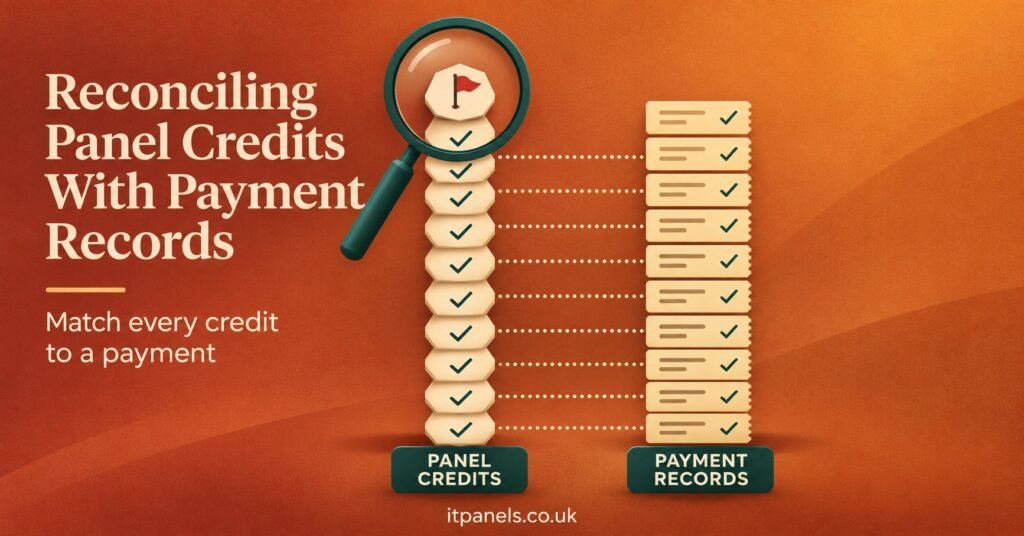
Verifying the figure before you trust it
A gross margin is only as good as the reconciliation behind it. Three checks catch most errors:
- Credits out should match lines created. Total credits consumed in your panel log should equal paid lines plus every unpaid, replacement or courtesy line you can name. Any gap means credits are leaving your balance unaccounted for.
- Payments in should match the processor’s payout report. Gross charges, refunds, disputes and fees on your payout statement should agree with your revenue and fee lines to the penny.
- Labour hours should come from a log. Monthly estimates drift. A simple time sheet does not.
If your panel records who created, extended or deleted each line, that history makes the first check much faster. The guide to an IPTV reseller panel audit trail explains which changes are worth recording.
Month-End Margin Checklist
- Export the panel’s credit log for the month and count consumption, not purchases
- Value credits at your weighted average cost per credit
- Separate paid lines from unpaid renewals, courtesy extensions and replacements
- Download the processor’s payout report and reconcile gross charges, refunds, disputes and fees
- Remove VAT from revenue if you are registered
- Total support hours from the time log and cost them at the real hourly rate, including your own time
- Keep sub-reseller credit sales and annual plans on their own lines
- Calculate gross margin, then compare each cost line with last month as points of net revenue
- Note the single largest change and decide one action for next month
Where to Take Your Numbers Next
An accurate IPTV Reseller Panel Gross Margin usually tells you something less obvious than “buy cheaper credits”. In the example, support labour costs more than ten times as much as unpaid renewals, and card fees outweigh the dispute. Start by running last month’s figures through the table above, using your own panel log and payout report rather than estimates. Then pick the largest cost line and change one thing: tighter device checks before a sale, extending lines only after payment clears, or nudging customers towards longer billing terms. Run the same calculation next month and you will see whether the change worked in points, not guesswork.
