

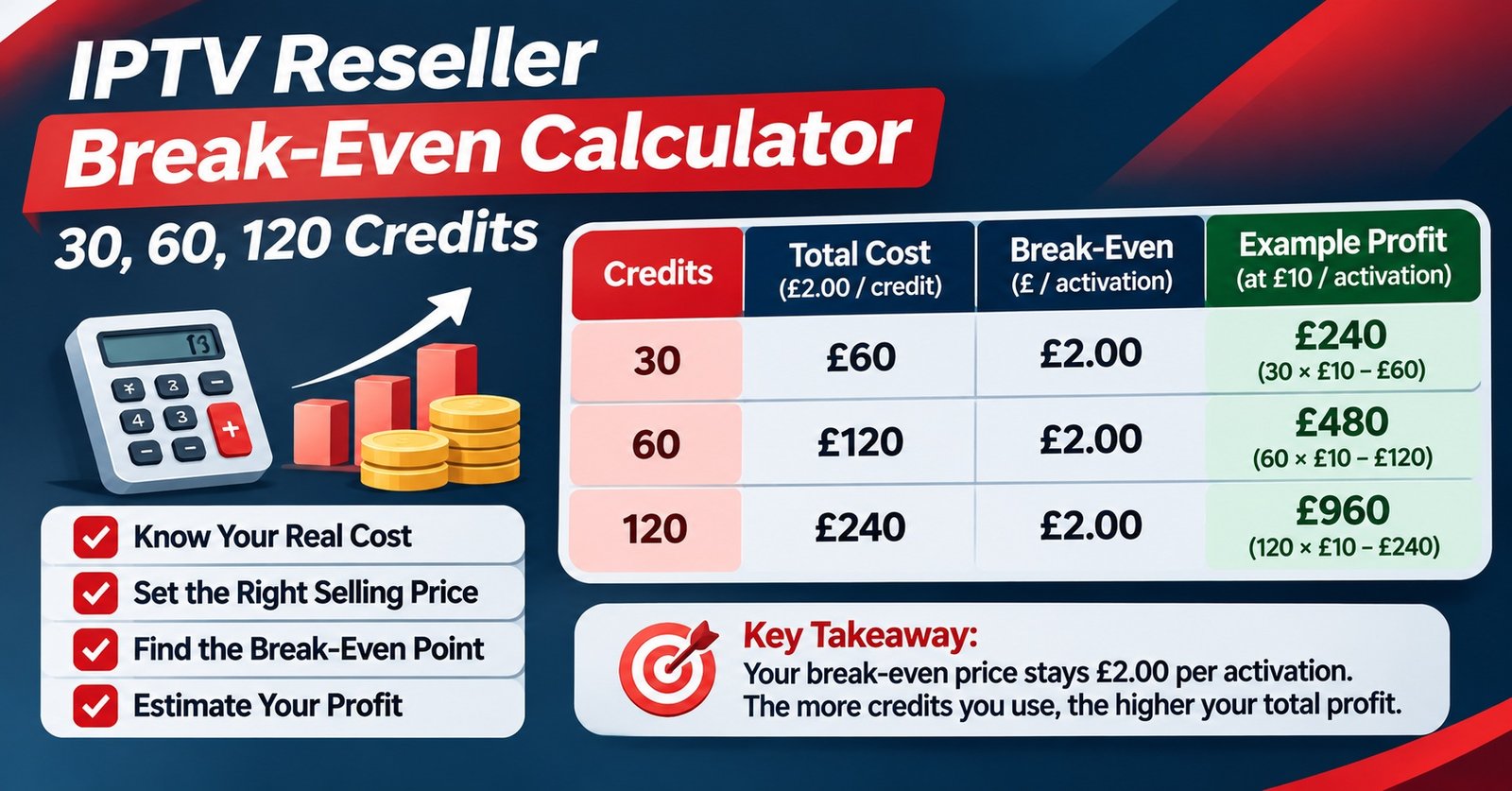
IPTV Reseller Break-Even Calculator: 30, 60, 120 Credits

An IPTV Reseller Break-Even Calculator answers one question: how many credits do you need to sell before a bundle has paid for itself? Take what you paid for the bundle, add the running costs for the time it takes to sell it, then divide by what you actually keep from each credit after payment fees. Round the answer up. That number is your break-even point, and you can compare it with the credits you can really sell, since some go on trials and replacements.
Most IPTV resellers get this wrong in the same place. They look at the cost per credit, compare it with the monthly price they charge, and see a healthy gap. That gap is real, but it hides three things. Annual discounts lower your real price per month, card fees take a cut of every sale, and a larger bundle takes longer to sell, so your fixed costs keep running in the meantime. The formula below puts each of these on its own line, so a bad assumption shows up before you buy.
[ez-toc]
The IPTV Reseller Break-Even Calculator, Written Out Line by Line
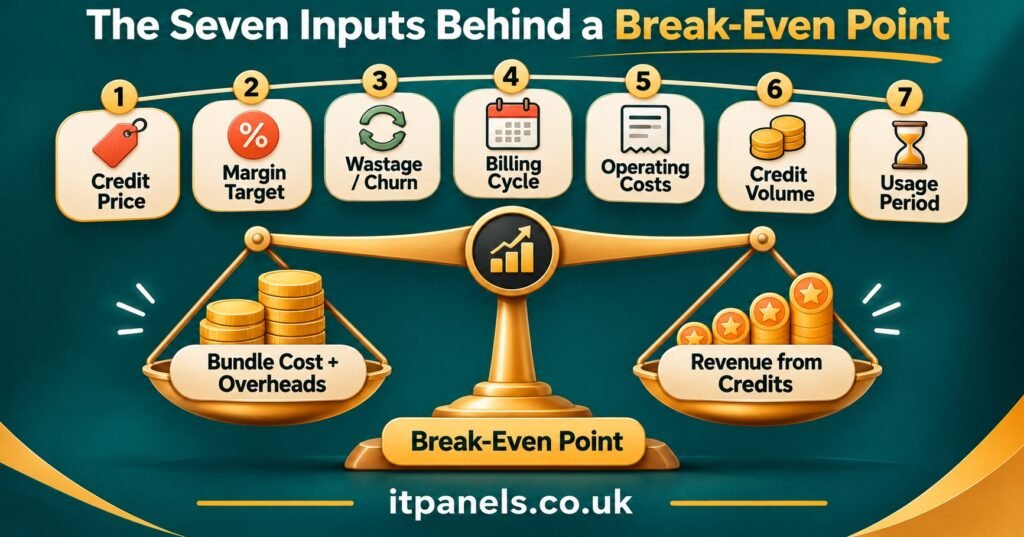
The full calculation uses seven inputs. Each one is a figure you can look up in your own records. None of them is a guess about the market.
- B is the number of credits in the bundle (30, 60 or 120 in the cases below).
- P is the total price you paid for that bundle.
- r is your blended retail price per credit, which is your average revenue for each month of service sold.
- e is the average payment fee taken from each credit you sell.
- w is wastage: credits used on trials, replacement lines, goodwill extensions and refunded activations.
- M is your fixed monthly overhead, such as your website, branded app costs, messaging tools and any panel subscription.
- T is how many months you expect the bundle to take to sell.
From these you calculate four results:
- Net revenue per credit: n = r − e
- Overheads carried by this bundle: F = M × T
- Break-even credits: k = (P + F) ÷ n, rounded up to the next whole credit
- Saleable credits and headroom: S = B − w, and headroom = S − k
If k is higher than S, the bundle can’t pay for itself on your current pricing, however hard you sell. If headroom is only a handful of credits, one bad month of refunds can wipe out the profit. The aim is a break-even point well inside the saleable stock.
The minus signs here are ordinary subtraction. Copy them into a spreadsheet exactly as written.
Five Figures to Check Before You Fill It In
Your real price per credit, not your headline price
On many panels one credit equals one month of service. That’s a common setup, but check what your provider’s panel actually does. A 12-month activation takes 12 credits at once, while the customer usually pays less per month than someone on a monthly plan. So your blended price r is total retail revenue divided by total credits used, not the price on your monthly plan.
A hypothetical example: you sell two annual plans at £75 each (24 credits) and six monthly plans at £10 each (6 credits). That’s £210 of revenue for 30 credits, so r = £7.00, even though your monthly price says £10. Every worked case below uses £7.00.
Fees per credit
Card processors and payment apps usually take a percentage plus a fixed charge on each transaction. To turn that into a per-credit figure, work out the fee on a typical sale and divide it by the number of credits that sale used. A fixed charge hurts monthly sales far more than annual ones, because one month carries the whole charge. The worked cases assume a blended fee of £0.30 per credit. Replace that with your own processor’s figure from your last statement.
Wastage you can count
Trials, replacement lines for customers changing device and goodwill days after an outage all use up credits that nobody pays for. Look back through your panel’s activation history and count them, rather than guessing a percentage. The cases below assume 2, 4 and 6 wasted credits for the 30, 60 and 120 bundles.
Overheads by the month
Include costs that run whether you sell or not: hosting, your domain, app branding fees, a helpdesk or messaging subscription and any reseller panel fee. The cases use £40 a month. Don’t include your own time unless you pay yourself a fixed wage from the business. If you do, it belongs here.
Sell-through time
This is the input people leave out, and it decides whether a bigger bundle is really better value. A 30-credit bundle might sell out within a month. A 120-credit bundle might take four, and your £40 overhead runs every one of those months. The cases assume one, two and four months.
Pro tip: Get T from history, not hope. Divide the credits you activated over the last three months by three, and you have a realistic monthly sell-through rate to set against any bundle size.
Three Bundles Run Through the Same Assumptions
The bundle prices below are hypothetical, chosen only to show how the formula behaves. They aren’t quotes from any provider. The 30-credit bundle costs £75 (£2.50 a credit), the 60-credit bundle £135 (£2.25) and the 120-credit bundle £240 (£2.00). All three cases use the same retail price, fees and overhead, so the only differences are size, wastage and time.
| Line | 30 credits | 60 credits | 120 credits |
|---|---|---|---|
| Bundle price (P) | £75.00 | £135.00 | £240.00 |
| Cost per credit (P ÷ B) | £2.50 | £2.25 | £2.00 |
| Net revenue per credit (n = £7.00 − £0.30) | £6.70 | £6.70 | £6.70 |
| Months to sell (T) | 1 | 2 | 4 |
| Overheads carried (F = £40 × T) | £40.00 | £80.00 | £160.00 |
| Break-even (P + F) ÷ n | 17.16, so 18 credits | 32.09, so 33 credits | 59.70, so 60 credits |
| Saleable credits (B − w) | 28 | 56 | 114 |
| Headroom (S − k) | 10 credits | 23 credits | 54 credits |
| Profit if all saleable credits sell | £72.60 | £160.20 | £363.80 |
Case one: 30 credits
You pass break-even at the 18th paid credit, which is about 64% of the saleable stock. That’s a fairly tight margin. Two refunds and a couple of extra trials would leave you only a few credits clear. The small bundle has one real advantage, though: it ties up the least cash and turns over quickly, so a pricing mistake costs you one month rather than four.
Case two: 60 credits
Break-even is the 33rd credit, roughly 59% of saleable stock, and headroom more than doubles. The lower cost per credit helps, but most of the gain comes from spreading £135 over twice as many sales. Overheads only double, from one month to two.
Case three: 120 credits
Here you need 60 paid credits to break even, about 53% of saleable stock, and the profit ceiling is highest. But all of it depends on selling through in four months. The money is spent on the first day and comes back slowly, so this bundle also asks the most of your cash flow.
Look at what the table doesn’t say. The 120 bundle comes out ahead only because these numbers assume it sells in four months. Change that assumption and the ranking can change.
What Moves the Break-Even Line Most
Changing one input at a time shows which ones matter most. Each line below changes a single figure from the cases above and leaves everything else the same.
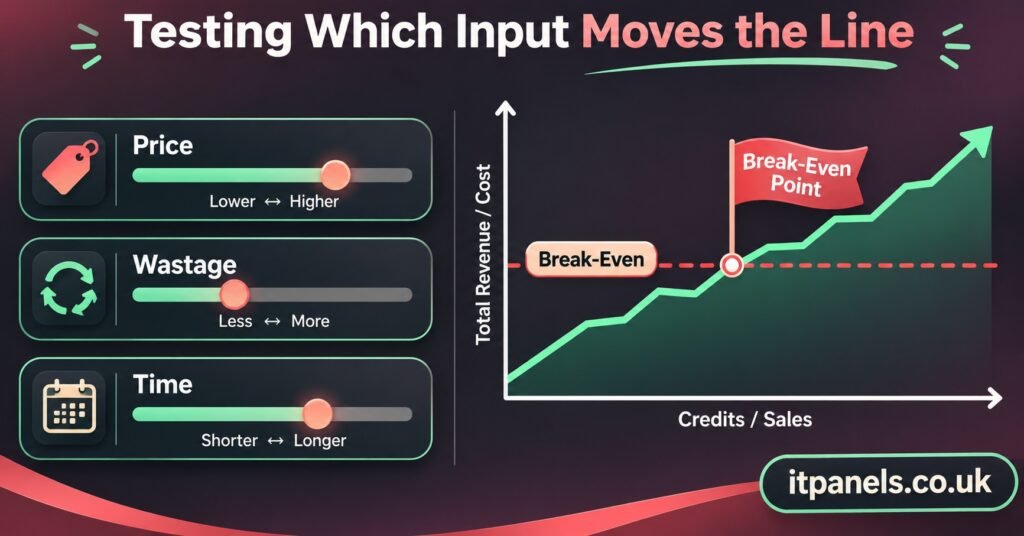
Retail price drops by £1 per credit. If more customers choose discounted annual plans and your blended price falls to £6.00, net revenue becomes £5.70. Break-even rises to 21 of 28 credits, 38 of 56 and 71 of 114. That’s 3, 5 and 11 more credits to sell before you make anything. Price has more effect than any other input because it changes every credit you sell.
Wastage doubles. With 4, 8 and 12 wasted credits, the break-even counts don’t change, because paid sales still have to cover the same costs. What shrinks is the stock left to make profit from: maximum profit falls to £59.20, £133.40 and £323.60. If you give out a lot of trials, this effect is easy to miss.
The large bundle sells slowly. If the 120 bundle takes six months instead of four, it carries £240 of overheads. Break-even rises to 72 credits and maximum profit drops to £283.80. Extend that further and the cheaper cost per credit no longer makes up for the time it takes to sell.
Taken together, these suggest an order of attention. Protect your blended price first, then size the bundle to how fast you really sell, then count your wastage. Getting a slightly better cost per credit matters less than all three.
Your Own Editable Version
Copy the table below into your notes or a spreadsheet and fill in the right-hand column with your own figures. Each example figure from the cases is shown next to it so you can see what goes where.
| Input | Worked example (60 bundle) | Your figure |
|---|---|---|
| Credits in bundle (B) | 60 | |
| Bundle price (P) | £135.00 | |
| Blended retail price per credit (r) | £7.00 | |
| Average fee per credit (e) | £0.30 | |
| Wasted credits (w) | 4 | |
| Monthly overheads (M) | £40.00 | |
| Months to sell through (T) | 2 |
To set it up in a spreadsheet, put the seven inputs in cells B2 to B8 in the order above, then add these four formulas:
- Net revenue per credit: =B4-B5
- Overheads carried: =B7*B8
- Break-even credits: =ROUNDUP((B3+B7*B8)/(B4-B5),0)
- Headroom: =(B2-B6)-ROUNDUP((B3+B7*B8)/(B4-B5),0)
Copy the column twice more and you can compare the 30, 60 and 120 bundles side by side using your own prices. If headroom comes out negative, that bundle won’t pay for itself at your current retail price.
Where the Arithmetic Stops Being Enough
A break-even figure is only as reliable as the provider behind the credits. Some panels have credits that expire, rules on whether unused credits roll over, or no refunds on activations. Those terms change how much risk sits in a large bundle, so read them before you treat 120 credits as stock you can sell slowly. If credits do expire, set T to that deadline at most, not to your expected sales pace.
The model also treats your revenue as earned the moment a customer pays. In practice, a customer on an annual plan expects support for twelve months, and support time costs you whether or not the formula counts it. If your panel provider has an outage, the replacement credits and goodwill days come out of your wastage, not theirs. So it’s sensible to build some slack into w rather than using your best month as the baseline.
There’s also one thing no calculation can fix. The numbers above assume you are reselling an authorised service that holds proper distribution rights for its content. IPTV is a way of delivering television over the internet. Whether a particular service is legal depends on licensing and on the law where your customers live. A professional-looking dashboard doesn’t show that the content is licensed. If you’re comparing panels and tools, the IPTV reseller panel options at itpanels.co.uk show the infrastructure side, but checking content rights is still your responsibility.
Questions Resellers Ask About Break-Even
Should I include trial credits in the break-even count?
No. Trials go in wastage (w), because they use stock without bringing in money. Counting them as sales makes your break-even point look reached sooner than it really is.
Does a cheaper cost per credit always make the bigger bundle better?
Only if you sell through it fast enough. In the cases above, a £0.50 per-credit saving on the 120 bundle was worth having at four months. At six months, extra overheads ate £80 of the gain. Work out your own sell-through rate before you decide.
How often should I rerun the numbers?
Rerun them whenever your plan mix changes, your provider changes its bundle prices, or your fees change. A shift towards annual plans quietly lowers your blended price, and you’d only notice if you recalculate.
Can I use this for sub-reseller pricing?
Yes. Treat the price your parent reseller charges you as P, and the price your own customers pay as r. Also check whether your parent account limits how many credits you can hold or move at once, because that can cap your bundle size whatever the maths says.
Making the IPTV Reseller Break-Even Calculator Earn Its Place
The IPTV Reseller Break-Even Calculator is most useful before you buy, not after. Put in your real blended price, the fees from your last statement, the wastage from your panel history and an honest sell-through time. Then choose the bundle with comfortable headroom rather than the lowest cost per credit. If none of the three bundles leaves a good margin at your current prices, the problem is your pricing or your plan mix, and a bigger bundle won’t fix it. Start with the bundle you already buy most often, fill in the editable table with this month’s figures, and see how much headroom you really have.
