

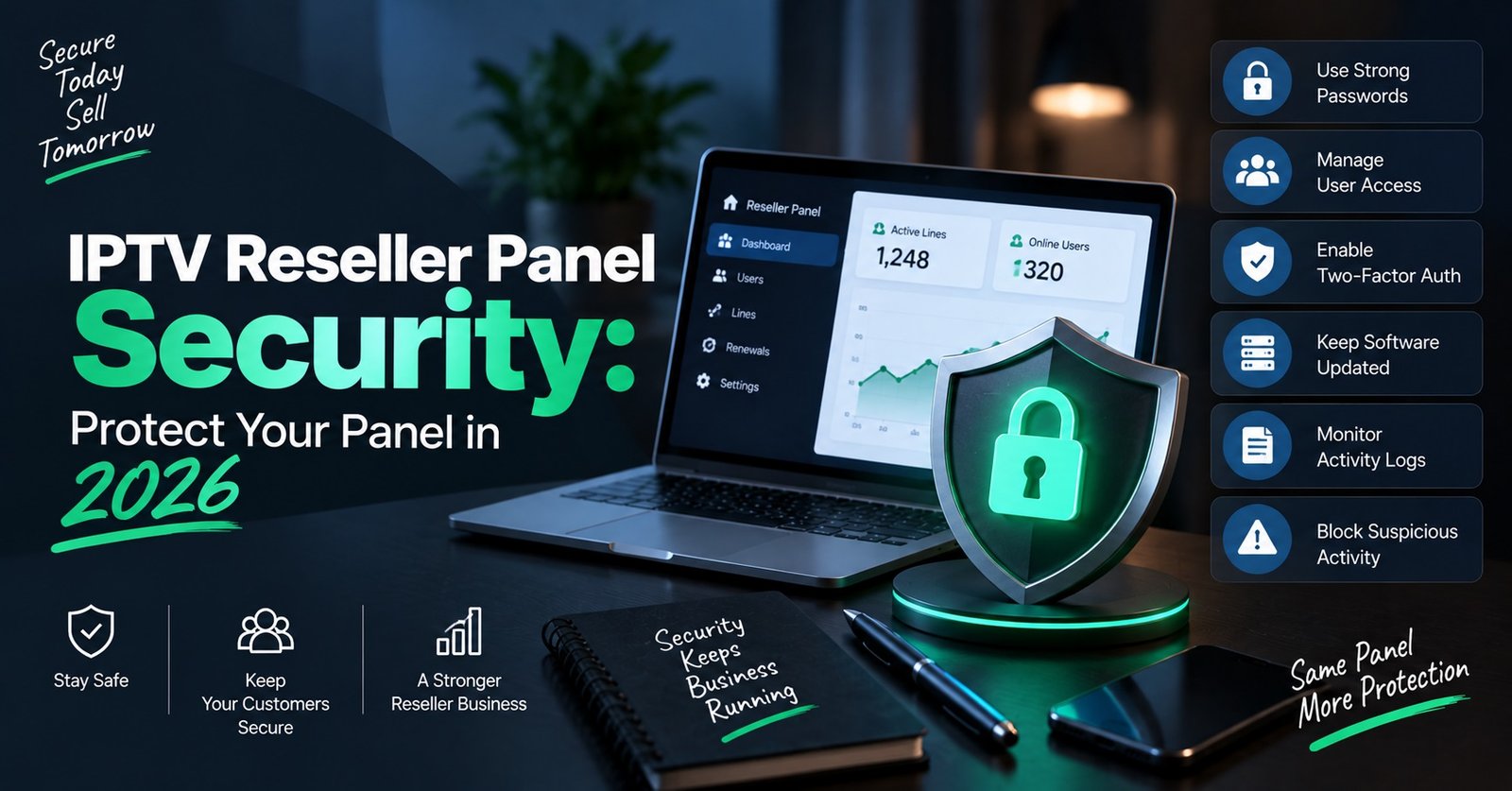
IPTV Reseller Panel Security: Protect Your Panel in 2026

IPTV Reseller Panel Security comes down to four things you genuinely control: how you sign in, which devices you sign in from, who else holds access to your dashboard, and how fast you can take that access away again. Everything else, the server hardening, the firewall rules, the backend patching, belongs to whoever operates the infrastructure behind your panel. Most reseller account compromises are not clever attacks on that infrastructure. They are ordinary credential problems: a reused password, a login typed into a fake page, or a dashboard left open on a shared machine.
That distinction matters because it changes where you spend your effort. A reseller worrying about server-side encryption while running the panel on the same browser profile used for casual downloads has the priorities backwards. Before anything else, check two things today: whether your panel password exists anywhere else in your life, and whether anyone who no longer works with you still has a working login. Those two checks close more real risk than any amount of technical reading.
The part of the stack you actually own
When you buy into a reseller panel, you are renting a management layer. The provider runs the servers, the load balancers, the databases holding line records, and whatever authentication system sits in front of the dashboard. You get an account inside it.
So your security perimeter is your account, your devices, your staff, and your customer records. That is a smaller surface than people expect, and it is almost entirely made of human decisions rather than technical ones. You cannot patch a server you do not own. You can absolutely stop your own login from ending up in a stealer log.
This also means provider selection is a security decision, not just a pricing one. If the backend is poorly run, no amount of personal discipline protects your customer base from an outage, a data exposure, or a panel that quietly disappears. The practical response is not to demand technical guarantees nobody can verify, but to avoid concentrating your entire business on infrastructure you know nothing about.
Where reseller accounts actually get reached
Compromises in this space follow a short list of routes. Knowing which one you are exposed to tells you what to fix first.
| Entry point | How it usually happens | What reduces it |
|---|---|---|
| Reused password | The same password appears in an unrelated breach and gets tried against your panel | A unique password per service, stored in a manager |
| Fake login page | A link arrives by message or email and mimics the panel sign-in | Bookmark the real URL and never sign in from a link |
| Infected device | Malware copies saved passwords and active browser sessions | A clean, dedicated machine or browser profile for business logins |
| Social engineering | Someone posing as support or a supplier asks for login details or a code | A fixed rule that credentials and codes are never shared, ever |
| Stale access | A former partner, employee or sub-reseller keeps a working account | Scheduled access reviews and immediate removal on departure |
The fifth row is the one resellers underestimate. Passwords get attention because they feel like security. Access that was legitimately granted and never revoked feels like admin, so it sits untouched for months.
Pro tip: Keep a plain text note of every person and every account that can reach your panel, with the date access was granted. It takes ten minutes to build and turns access review from guesswork into a five-minute task.
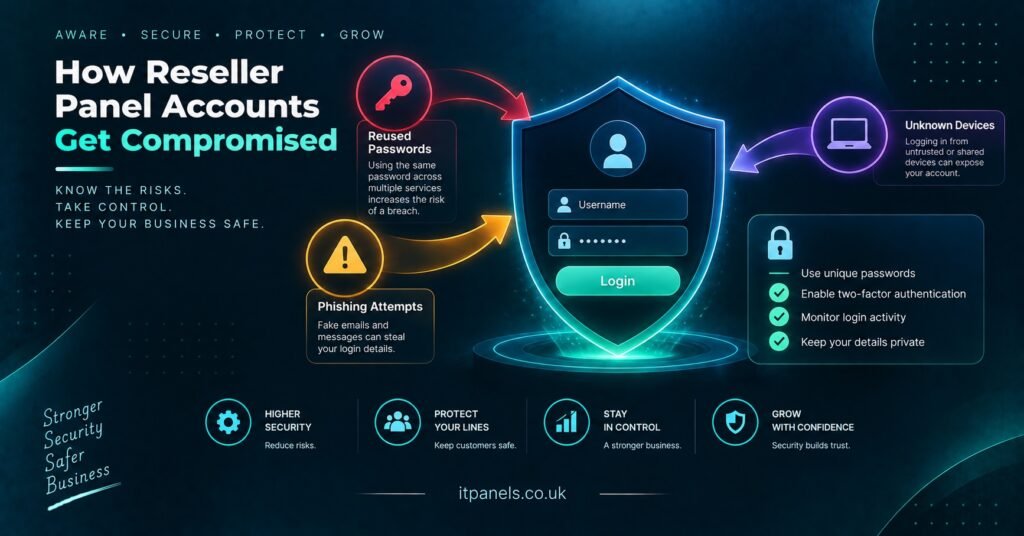
IPTV Reseller Panel Security starts at the sign-in screen
Strong IPTV Reseller Panel Security is mostly authentication hygiene, done properly and then left alone. The specifics have shifted over the past couple of years, and some long-standing advice is now actively unhelpful.
Forced monthly password changes are one example. Rotating a password on a schedule pushes people towards predictable patterns, which is weaker than one long, unique password kept until there is a reason to change it. The UK’s National Cyber Security Centre now recommends passkeys over passwords wherever a service supports them, since a passkey cannot be typed into a convincing fake page. Reseller panels vary widely in what they offer, so check what your provider actually supports rather than assuming.
Where only a password and a code are available, an authenticator app beats SMS. Number porting attacks are well documented and a phone number is not a secret. Where nothing beyond a password exists, your compensating control is a unique password of real length plus strict device discipline.
Account Hardening Checklist
- A unique password for the panel, not shared with email, hosting, payment tools or messaging accounts
- The strongest second factor your panel offers, with SMS treated as a last resort
- The panel URL saved as a browser bookmark, used every time instead of clicking links
- Recovery email secured to at least the same standard as the panel itself
- A separate browser profile, or ideally a separate machine, for business logins
- Saved sessions closed properly rather than left open on shared or family devices
- Access list reviewed on a fixed date each month rather than when something feels wrong
Two-factor helps less than most resellers assume
This is the part worth understanding properly, because it changes how you think about being safe.
Two-factor authentication protects the moment of sign-in. Once you have signed in successfully, the service hands your browser a session token so it does not challenge you on every click. Malware sitting on your machine can copy that token, and an attacker replaying it arrives already authenticated. No password prompt, no code request. The second factor did its job and was simply stepped around.
Adversary-in-the-middle phishing pages work on similar logic. They relay your real login to the real panel, capture what comes back, and let you through so nothing looks wrong. Passkeys defeat this particular route because the credential is bound to the genuine site address, but they do not stop malware already resident on a compromised device.
The operational conclusion is unglamorous. Device cleanliness carries roughly as much weight as your login method. A reseller panel opened only on a well-maintained machine with a browser used for nothing risky is in a materially better position than one protected by two-factor and opened on a laptop shared with three other people.
Pro tip: Treat any unexplained logout, session expiry or unfamiliar device notice as a signal rather than a glitch. Change the password from a different device and end all active sessions before carrying on.
Access, permissions and the sub-reseller problem
Once you bring anyone else into the operation, security becomes a permissions question rather than a password question.
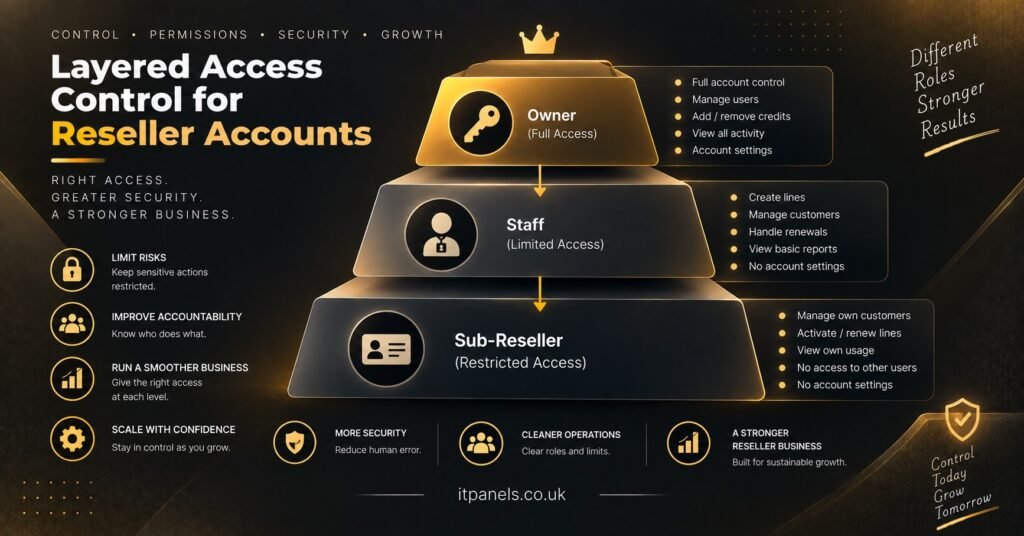
Sub-reseller accounts are the common pressure point. You grant credits and a dashboard, and from that point the person below you can create lines, set their own pricing and hold their own customer relationships. If their account is compromised, the credits consumed are yours. If they leave on bad terms, the customers they built may leave with them. Neither of those is a technical failure, but both are outcomes of how access was structured.
A few working principles hold up well in practice. Give the minimum permission level that lets someone do their job, rather than the level that saves you future requests. Keep one account per person instead of a shared login, because a shared login cannot be revoked without disrupting everyone. Confirm in writing what a sub-reseller can and cannot do before any credits change hands, including what happens to their customer lines if the arrangement ends.
Staff access deserves the same discipline. An operational assistant who renews lines does not need permission to transfer credits or change account settings. If your panel supports role separation, use it. If it does not, that limitation is worth factoring into your provider comparison.
Your customer list is the asset people forget to protect
IPTV Resellers concentrate on panel access and then keep customer names, contact numbers, payment references and subscription dates in a spreadsheet on a personal laptop with no backup and no password.
That file is your business. It is also personal data, which brings responsibilities that exist regardless of what you are selling. Anyone handling customer information in the UK and most English-speaking markets has obligations around keeping it secure, collecting only what is needed, and being able to respond if it is exposed. Storing less is genuinely easier than protecting more.
Practical version: keep the customer record minimal, hold it somewhere encrypted and backed up, do not circulate it through chat apps, and separate it from credentials entirely. Customer logins and your own panel login should never live in the same document.
It is also worth being clear in your own head about what you are actually selling. IPTV is a delivery technology, and the legality of what travels over it depends on the rights and permissions held by whoever supplies the content, plus local requirements in the market you serve. A professional website and a card payment option tell you nothing about either. Understanding your supply chain is part of risk management, not a separate legal topic.
When you think an account has already been reached
Speed matters more than diagnosis here. Work in this order.
Change the panel password first, from a device you have reason to trust rather than the one you suspect. Then end all active sessions, if the panel offers that option, because a password change alone does not always invalidate a stolen token. Secure the recovery email next, since an attacker who holds that can undo everything you just did.
After that, look at what moved. Check credit balance against your own records, look for lines you did not create, and check whether any account details or contact addresses were altered. Contact your provider with specifics rather than a general alarm, because timestamps and line IDs get you a faster response than a description of the panic.
Finally, deal with the device. If malware is the likely route, changing passwords on an infected machine simply hands over the new ones. That machine comes out of service until it is cleaned or rebuilt.
Questions worth putting to a panel provider
Security questions are also provider evaluation questions, and the answers tell you a lot about how the operation is run.
Ask what second-factor options the dashboard supports, and whether passkeys are on the roadmap. Ask whether you can see active sessions and end them yourself. Ask what the recovery process looks like if you lose access, and specifically how they verify that the person asking is you, because a weak recovery process is a security hole no matter how strong the login is. Ask whether role-based permissions exist for staff and sub-resellers. Ask what happens to your customer lines if you move away, since account portability is a continuity issue as much as a commercial one.
Vague or irritated answers are informative. A provider running a serious operation can describe its own recovery procedure without hesitation. If you are still comparing options, it is worth reviewing the reseller panel and credit packages available through itpanels.co.uk alongside these questions rather than judging on price alone.
Frequently Asked Questions
Should I change my panel password on a regular schedule?
Not without a reason. Scheduled changes tend to produce weaker, more predictable passwords. Change it when there is a trigger: a suspected compromise, a departing staff member, a device you no longer trust, or a breach notification involving a service where you reused it.
Is it safe to manage a reseller panel from a mobile phone?
Reasonably, provided the phone is kept updated, locked with biometrics or a strong PIN, and free of apps installed from outside the official stores. Phones are often cleaner than shared desktops. The genuine risk is convenience: staying permanently signed in on a device that regularly leaves your hands.
What should I do when a sub-reseller stops working with me?
Revoke the account the same day rather than letting it lapse. Reconcile any outstanding credits first, record which customer lines were created under that account, and agree how those customers are handled before access is removed, so the commercial side is settled and the technical side is clean.
Can my provider see my customer records?
The provider necessarily holds the line data created on their infrastructure, since that is what the panel runs on. Whether they can see contact details, pricing or personal notes depends on what you have entered into the panel versus what you keep in your own records. Assume anything typed into the dashboard is visible to the operator.
Does two-factor authentication make my account safe?
It makes it substantially harder to attack, which is not the same as safe. It protects sign-in, not the session that follows, and it does nothing about an account that a former colleague still holds. Treat it as one control among several rather than the finished job.
Where this leaves you
Good IPTV Reseller Panel Security is less about technical sophistication than about a handful of habits held consistently: one unique login that exists nowhere else, the strongest second factor your panel supports, a clean device used for business work, a short and current list of who holds access, and a customer record that is minimal, encrypted and backed up.
The honest limitation is that none of this protects you from problems in infrastructure you do not operate. A provider with poor practices remains a risk your own discipline cannot fully offset, which is why provider evaluation and account hygiene are two halves of the same job rather than separate concerns.
If you do one thing after reading this, make it the access review. Open your panel, list every account that can reach it, and remove the ones that no longer need to be there. It is the cheapest, fastest improvement available, and it is the one most resellers have never actually done.
A note on links: itpanels.co.uk blocks automated access, so I could only verify and use the homepage rather than selecting two to four internal article URLs. If you send me the live blog URLs you want linked, I will swap them in with contextual anchors.

[…] under their account. A pattern of flagged or abused lines can lead to warnings, restrictions on the IPTV reseller account, or in some cases closure, and credits already spent on disabled lines are usually not […]