

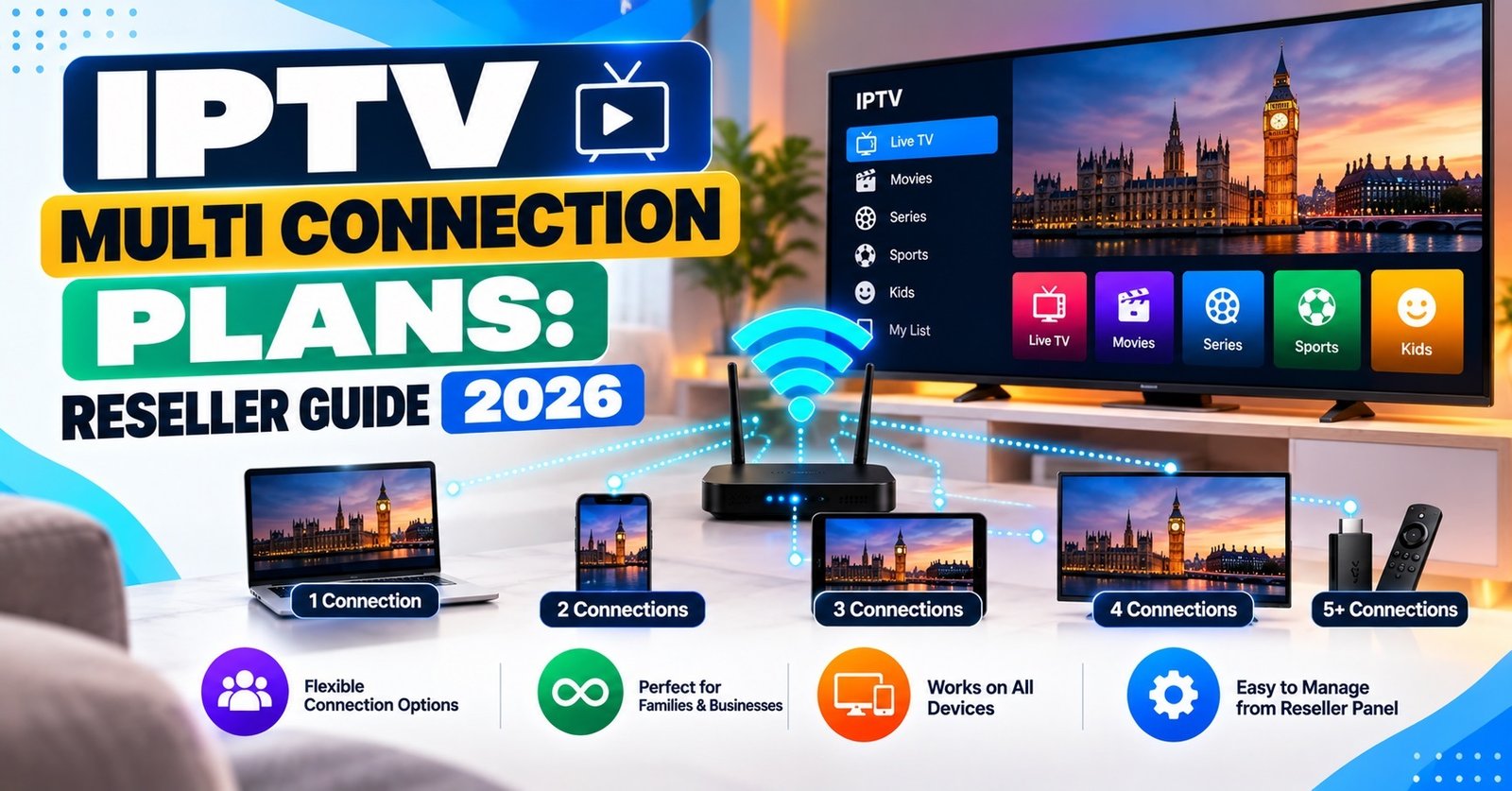
IPTV Reseller Multi Connection Plans: Pricing Guide 2026

IPTV Reseller Multi Connection Plans come down to one pricing decision: you sell a single login that can stream on two, three or four screens at the same moment, and you price each step so that a one-screen customer never feels pushed into capacity they will not use. Keep the ladder short, price it by real household situations and make sure each tier costs you less per connection than selling separate lines.
The customers who genuinely need extra connections are usually the ones who have already hit the limit. They tell you the picture stops when someone else switches on a second TV, or that the evening stream drops when a phone is in use. Before you set a single retail price, find out how your panel deducts credits for added connections, because that cost is the floor under every plan you create.
What a connection actually limits
A connection limit is the number of streams a line can play at once. It is not a count of devices. A customer can install the app on five screens and still be fine, as long as no more than the allowed number are playing together. Most disputes about multi-connection plans start with this misunderstanding, so it is worth explaining in your sales message before any price appears. Our guide on why connection limits cut off a second screen covers the customer-facing explanation in more detail.
It also helps to keep content rights separate in your own mind. IPTV is a delivery technology, and whether a given service is lawful depends on the rights and permissions behind the content, not on how many connections a plan carries. Describe your plans as technical access limits and nothing more.
The cannibalisation problem is really two problems
When IPTV panel resellers say a multi-connection tier cannibalises the single-line plan, they usually mean one of two different things, and the fixes are opposite.
The first problem is the tier sitting too close in price to the single line. If the two-connection plan costs only a little more, people who watch alone will take it “just in case”. You earn slightly more per customer, but you have also given away the clear reason to choose the cheaper plan, and your support team will field more questions about which one to pick.
The second problem is the tier sitting too far away. If the gap is large, a couple will buy two separate single lines instead. That sounds like extra revenue, and in credit terms it often is, but you now manage two logins, two expiry dates and two renewal conversations for one household. The customer also loses the convenience of one account.
The workable middle is a tier priced clearly above the single line and clearly below two of them, sold by situation instead of by feature. Someone living alone is offered the single line. Two people who watch at the same time in the evening are offered the two-connection plan. You are describing who the plan is for, which is much harder for a customer to misjudge than a bare number.
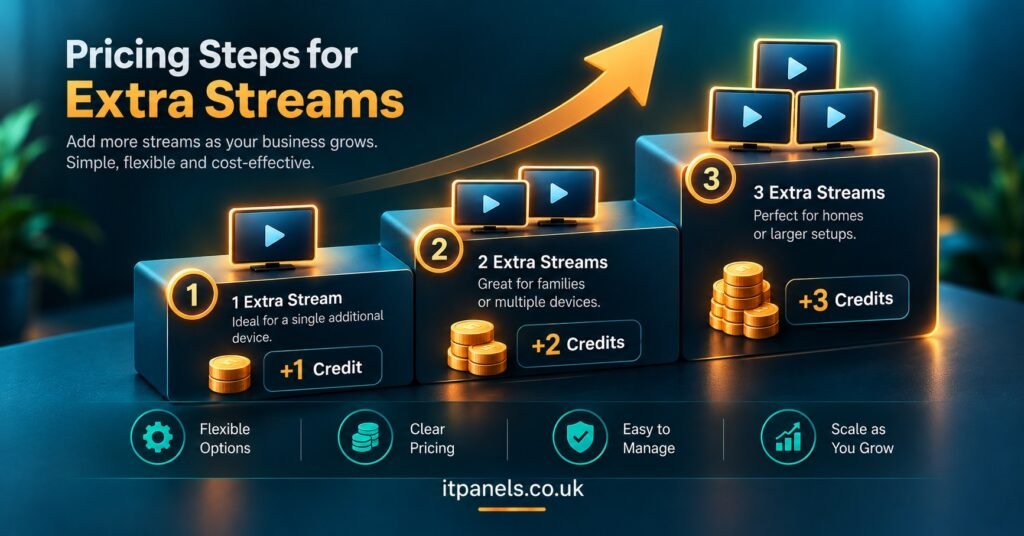
How IPTV Reseller Multi Connection Plans Change Your Credit Maths
Panels differ in how they charge for connections. Some deduct a fixed number of credits per connection per month. Others use a scale where each extra line costs less than the first. Some let you choose the connection count when the account is created, and the account wizard simply applies the cost. You need to know which model you are on, because everything else follows from it.
Work it out in three steps. Write down the credit cost of one connection-month and of each higher tier on your panel. Convert that into your own cost using what you paid for your credits. Then set the retail price so that every tier covers its cost with a margin you are happy with, and so that the per-connection price drops slightly as the tier rises. If a three-connection plan costs you more than three times a single line, do not sell it at a discount, whatever competitors do.
Do not borrow percentages or margin figures from other resellers. Their credit cost, region and support load are not yours. If you want to check what your own credit packs allow, the IPTV reseller plans page shows how credit packs are structured, and your own panel will show exactly what each connection count costs you per month.
| Customer situation | Plan to offer | Watch out for |
|---|---|---|
| One viewer, one main screen | Single connection | Do not upsell if they never overlap |
| Two people watching together in the evening | Two connections | Confirm it is simultaneous use, not just two devices |
| Family with several rooms in use at once | Three or four connections | Check whether use stays within one household |
| Customer who wants a spare for travel or a second home | Two connections, or a separate line | Separate lines suit different locations better |
Selling the upgrade at the moment it makes sense
The best time to offer a higher tier is when the customer has just run into the limit. A message such as “it stops when my partner turns on the other TV” is a clear signal. You can answer it honestly: the line allows one stream at a time, and a two-connection plan removes that clash. That is a customer need being met, not a pressure sale, and it rarely drags the single-line price down because you have not discounted anything.
Renewal is the second natural point. Before a line renews, a quick message asking whether the household has changed since the last term costs nothing and catches the families whose habits have outgrown their plan. Avoid offering multi-connection tiers to every customer as a default. Doing so teaches single-line customers that they are on the cheap option and may leave them wondering what they are missing.
Pro tip: Name tiers by use, such as “One screen”, “Two screens at once” and “Three or more”, instead of “Basic”, “Plus” and “Premium”. Plain names stop customers guessing what the extra money buys.
Where support gets harder with extra connections
More connections mean more ways for a line to be used in ways you did not plan. Three habits keep this manageable.
First, record the connection count against the customer in your notes at the point of sale. When someone writes in weeks later saying their stream drops, you should be able to see at once whether they are on a one-connection or three-connection line, without searching your messages. If you reconcile credit spending later, having the count beside each renewal makes the credit log far easier to match against actual customers.
Second, decide in advance what happens when a customer wants to move up or down mid-term. Some panels let you adjust the count on an existing line, while others need a new account or a different credit treatment. Whatever your panel does, write your own rule for it and apply it consistently, or you will end up making individual decisions that customers compare.
Third, be clear about fair use. A multi-connection line is meant for one household or group, not for passing around to unrelated people. Our piece on account sharing limits and fair use is a useful reference when you write the terms for your tiers.
Pro tip: If you have sub-resellers, give them the same tier names and the same connection options you use yourself. Matching tiers mean your support answers stay the same whoever the customer bought from.
Mistakes that quietly cost margin
The most common mistake is creating too many tiers. A single, two and three-or-more ladder is usually enough, and every extra tier adds a question for the customer and a rule for you to remember. Close behind is discounting the second connection heavily to win a sale, which resets the customer’s expectation for every future renewal and eats directly into the margin you calculated earlier.
Another costly habit is promising “unlimited devices” in marketing copy. It sounds friendly, but it blurs the difference between devices and simultaneous streams, and it creates arguments you cannot win. State the connection count plainly and say what it means in one sentence.
Finally, avoid treating a failed stream as a plan problem when it is not. Before you suggest an upgrade, rule out a network or device issue, since selling a higher tier to someone whose problem is a weak connection leads to a refund request, not a happy customer.
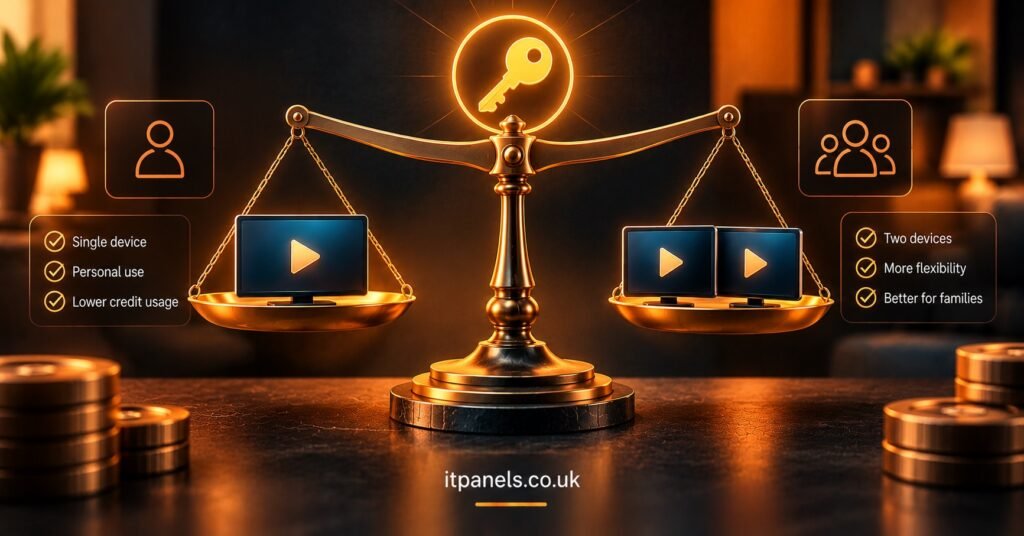
Questions resellers ask before launching extra tiers
Should I sell two single lines or one two-connection line to a couple?
A single two-connection line is easier for you to support and for the customer to manage. Two single lines give you a separate login and expiry date for each person, which suits households that watch in different places or renew at different times. Offer both and let the situation decide.
Is a multi-connection plan the same as allowing more devices?
No. It allows more streams to play at once. The customer can usually install the app on many devices, but only the allowed number can play together.
Do I need to publish a price for every connection count?
Not necessarily. Many IPTV panel resellers publish the single line and one or two upgrade options, and quote anything larger on request. That keeps the page simple and lets you check the customer’s real need before you price it.
How do I stop a household plan being shared widely?
Put the fair-use rule in your terms, explain it at the point of sale and keep an eye on support messages for signs of unrelated users. Clear wording at the start prevents most problems later.
Where this leaves your pricing
IPTV Reseller Multi Connection Plans pay off when the ladder is short, the gaps are deliberate and every tier covers its credit cost with room to spare. Price above the single line but below two of them, sell by household situation, and offer upgrades when a customer has actually hit the limit. The main limitation is that credit costs and connection rules differ between panels, so no outside figure can replace your own calculation. Start by writing down what each connection count costs you today, then build two tiers from that and review them after a few renewal cycles.
Reseller Checklist for Multi-Connection Tiers
- Confirm how your panel charges credits for each connection count
- Calculate your cost per connection-month for every tier
- Price each tier above the single line and below two single lines
- Name tiers by how they are used, not by vague labels
- Record the connection count in the customer’s notes at sale
- Write a rule for mid-term upgrades and downgrades and apply it consistently
- State the fair-use limit in your terms and at checkout
- Rule out network and device faults before suggesting an upgrade
- Use the same tier names and options across any sub-resellers
