

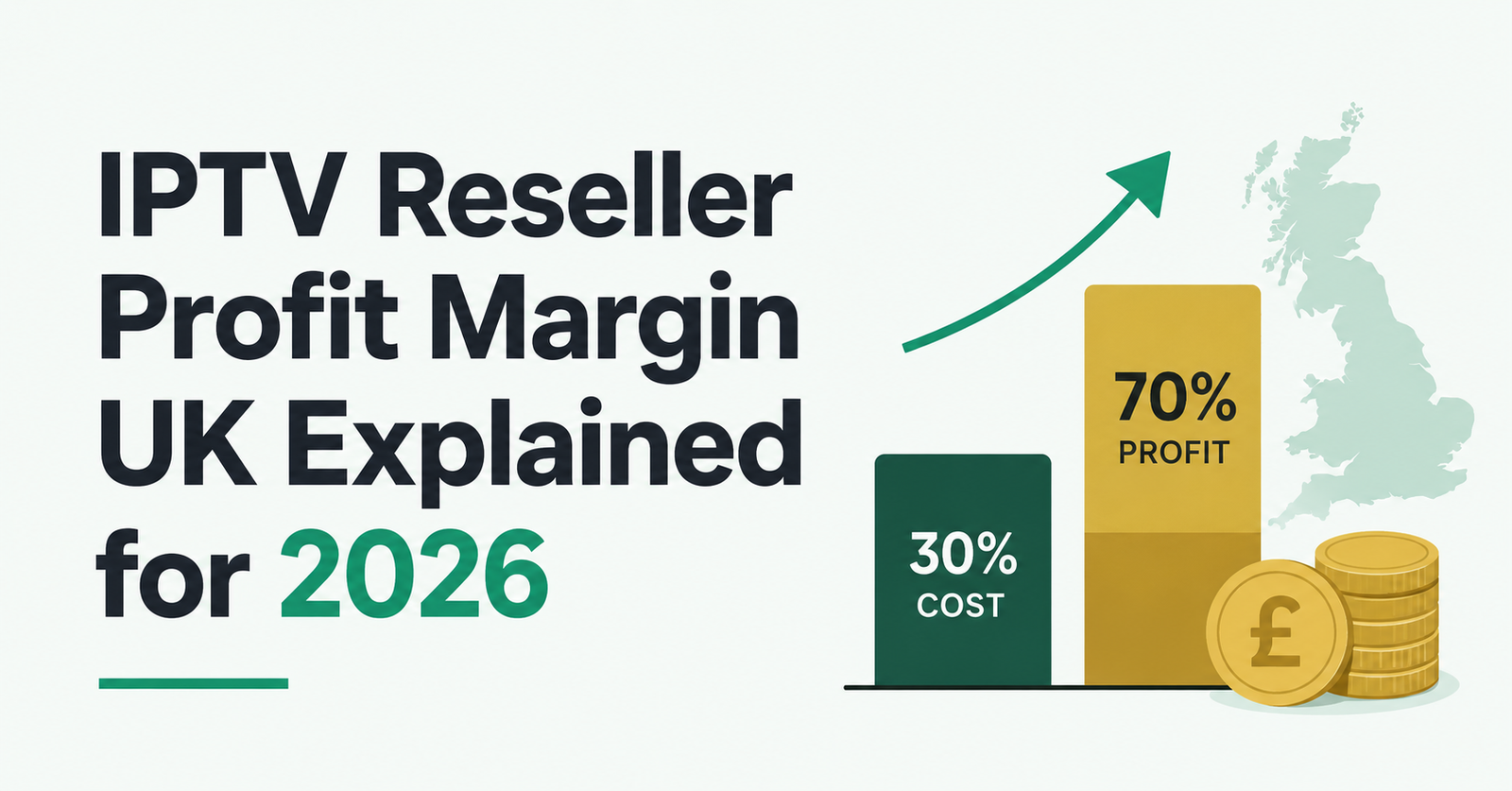
IPTV Reseller Profit Margin UK Explained for 2026

IPTV Reseller Profit Margin UK figures come down to three numbers you control directly: what you pay per credit, what you charge subscribers, and how much time and money you spend keeping those subscribers once they’ve signed up. Nothing about it is fixed. Two IPTV Panel resellers buying the same size credit pack can end up with completely different margins depending on how they price, how many refunds they issue, and how much support they give away for free.
That’s the part most guides skip. They’ll tell you credits get cheaper in bulk, which is true, but cheaper credits only translate into a better margin if your pricing and customer retention hold up. This article walks through where the margin actually comes from, what quietly eats into it, and how to work out a realistic number for your own setup rather than relying on someone else’s headline figure.
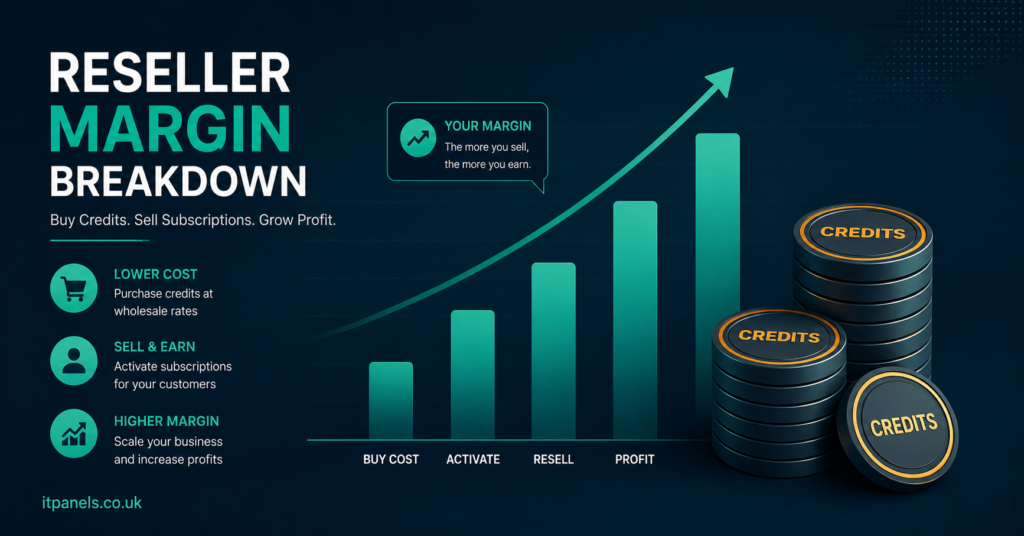
Where the margin starts: cost per credit
Every reseller panel prices credits in tiers, and the tier you buy into sets the floor for your margin before you’ve sold a single subscription. Smaller packs carry the highest cost per credit because you’re paying for flexibility rather than volume. Larger packs bring the per credit cost down, but they also mean more money sitting in unsold stock while you wait for customers.
This is the trade off that catches new resellers out. Buying a large pack purely to chase a lower unit cost doesn’t help your margin if half those credits are still unused three months later. A reseller checking current tier pricing before committing to a pack size usually gets a clearer picture of where the real breakeven point sits for their expected customer count.
IPTV Reseller Profit Margin UK: working out your real number
The calculation itself is simple. Take what a customer pays you for a subscription period, subtract the credit cost for that period, and what’s left is your gross margin before overheads. Overheads are where most people stop calculating and just guess.
Say you’re paying somewhere in the middle of the tier range per credit, and you’re charging a monthly rate that competitors in your area also charge. Your gross margin per subscriber might look healthy on paper. But that figure only holds up once you’ve also accounted for payment processing, any app or player licensing you pass on, and the hours you personally spend on customer support each month. A genuine IPTV Reseller Profit Margin UK figure has to include that last part, because unpaid support time is still a cost, even if it doesn’t show up on an invoice.
Here’s a rough shape of how pack size tends to affect the margin ceiling:
<div style=”border: 0.5px solid var(–border-strong); border-radius: 12px; overflow: hidden;”> <table style=”border-collapse: separate; border-spacing: 0; width: 100%; font-size: 14px;”> <tr style=”background: var(–surface-1);”> <th style=”padding: 12px 16px; border-bottom: 0.5px solid var(–border-strong); border-right: 0.5px solid var(–border-strong); text-align: left;”>Credit pack size</th> <th style=”padding: 12px 16px; border-bottom: 0.5px solid var(–border-strong); border-right: 0.5px solid var(–border-strong); text-align: left;”>Typical cost per credit</th> <th style=”padding: 12px 16px; border-bottom: 0.5px solid var(–border-strong); text-align: left;”>Effect on margin</th> </tr> <tr> <td style=”padding: 12px 16px; border-bottom: 0.5px solid var(–border-strong); border-right: 0.5px solid var(–border-strong); color: var(–text-secondary);”>Small starter pack</td> <td style=”padding: 12px 16px; border-bottom: 0.5px solid var(–border-strong); border-right: 0.5px solid var(–border-strong);”>Highest per credit rate</td> <td style=”padding: 12px 16px; border-bottom: 0.5px solid var(–border-strong);”>Thinnest margin, but lowest risk while testing demand</td> </tr> <tr> <td style=”padding: 12px 16px; border-bottom: 0.5px solid var(–border-strong); border-right: 0.5px solid var(–border-strong); color: var(–text-secondary);”>Mid size pack</td> <td style=”padding: 12px 16px; border-bottom: 0.5px solid var(–border-strong); border-right: 0.5px solid var(–border-strong);”>Noticeably lower rate</td> <td style=”padding: 12px 16px; border-bottom: 0.5px solid var(–border-strong);”>Margin improves once customer numbers are steady</td> </tr> <tr> <td style=”padding: 12px 16px; border-right: 0.5px solid var(–border-strong); color: var(–text-secondary);”>Large pack</td> <td style=”padding: 12px 16px; border-right: 0.5px solid var(–border-strong);”>Lowest standard rate</td> <td style=”padding: 12px 16px;”>Best margin per credit, but capital is tied up until sold</td> </tr> </table> </div>
Costs that quietly pull the margin down
Credit cost is the visible expense. The ones that dent margin without anyone noticing tend to sit elsewhere. Refunds and chargebacks are the obvious one, but they’re rarely budgeted for until a reseller has already lost a few sales to them. Every refund doesn’t just cost the credit already spent, it costs the time spent setting up and troubleshooting that account too.
Support load works the same way. A reseller with ten customers can answer every message personally with no real cost attached. A reseller with two hundred customers spending an hour a day on connection issues, buffering complaints, and device setup questions is effectively working an unpaid part time job that never shows up in the margin calculation.
Pro tip: Track how many minutes you spend per customer per month for a few weeks. If that number is climbing faster than your customer count, your margin is shrinking even if your prices haven’t changed.
Currency and payment fees matter too, particularly for resellers taking international payments or converting between currencies to top up credits. A few percent lost to processing fees on every transaction adds up once you’re running dozens of renewals a month.
Pricing without guessing
Undercutting the market to win customers is the fastest way to shrink a margin permanently, because pricing is much easier to lower than it is to raise later. Once a customer is used to paying a low monthly rate, moving them up even slightly tends to trigger cancellations, regardless of how good the service has been.
The more sustainable approach is pricing around your actual cost per credit plus a margin that covers support time, not just matching whatever the cheapest competitor is charging. Reviewing current reseller panel pricing gives a sense of where the market sits before you settle on a number, but your final price should reflect your own overheads, not someone else’s.
Pro tip: Build your support time into the price from day one rather than treating it as a hidden cost. It’s far easier to price it in upfront than to raise prices later once customers expect a certain rate.
Does scaling up actually improve margin?

Moving into larger credit packs and eventually sub reseller status does lower your cost per credit, but it also raises the stakes. A sub reseller distributing credit blocks to their own resellers takes on account management and support responsibilities that a single reseller selling directly to subscribers doesn’t have. The margin per credit improves, but so does the operational workload behind it.
Anyone thinking about that step is usually better off reading through what becoming an IPTV Panel reseller in the UK actually involves at each stage, rather than jumping straight to the largest available pack because the per credit rate looks best on paper.
Mistakes that erode margin over time
A few patterns show up repeatedly among resellers whose margin quietly disappears over a year of trading. Buying credits reactively, in small top ups, rather than planning ahead, keeps the cost per credit permanently high. Offering unlimited free trials to every enquiry adds up in unused credits that never convert to paying customers. And treating every customer complaint the same way, regardless of whether it’s a genuine service issue or just unfamiliarity with a new device, burns support hours that a clearer setup guide could have prevented.
None of these mistakes are dramatic on their own. They’re small, repeated decisions that compound over months, which is exactly why they’re easy to miss until the margin has already thinned out.
Frequently asked questions
Does a bigger credit pack always mean a better margin?
Only if the credits get used at a steady rate. A large pack sitting half unused for months ties up money that a smaller, more frequently topped up pack wouldn’t.
How much of my revenue should go towards support?
There’s no fixed figure, but it’s worth tracking as a real cost. If support time is eating a large share of your margin, that usually points to a setup or documentation gap rather than difficult customers.
Is sub reseller status worth it just for the margin improvement?
The per credit rate improves, but only take that step once you have the customer volume and support capacity to manage the extra workload it brings.
Should I price to match the cheapest reseller I can find?
Matching the lowest price in the market usually means matching the thinnest margin too. Pricing around your own costs tends to hold up better over time.
Reseller Margin Checklist
- Know your exact cost per credit for the pack size you’re actually using, not the headline rate for the largest tier
- Track refunds and chargebacks separately so they don’t disappear into general costs
- Log support time per customer for at least a month before assuming it’s negligible
- Price around your own overheads rather than the cheapest competitor you can find
- Reassess your pack size every few months against how many credits you’re actually using
- Hold off on sub reseller status until support capacity, not just pricing, is ready for it
A realistic IPTV Reseller Profit Margin UK figure only comes from tracking your own costs rather than assuming a lower credit rate automatically means more profit. The credit cost sets the ceiling, but support time, refunds, and pricing decisions are what actually determine whether that margin survives past the first few months. Start by knowing your true cost per credit, price with your overheads included rather than guessing against competitors, and revisit the numbers regularly as your customer base changes.
