

IPTV Reseller Pricing Strategy UK: Maximize Profits 2026

IPTV Reseller Pricing Strategy UK planning starts with a decision most resellers skip: whether you’re competing on price, on margin, or on the support you wrap around the subscription. Get that decision wrong and every number you set afterwards, from your entry tier to your renewal rate, ends up fighting against itself.
Start With What You’re Actually Selling Before Setting a Price
A price tag only makes sense once you know what it’s meant to represent. Some UK IPTV Panel resellers are effectively selling access at the lowest workable cost, competing purely on being cheaper than the next panel. Others are selling reliability and hand holding, charging more because they answer messages quickly and sort problems out without the customer having to chase them. Neither approach is wrong, but pricing as though you’re the second option while behaving like the first is where most subscriber churn actually comes from.
This matters more in the UK market than it might first appear, because customers comparing IPTV subscriptions tend to notice inconsistency quickly. A £6 monthly price with slow replies to a buffering complaint reads as poor value, even if £6 would be entirely fair for a barebones, self-serve service. The mismatch between price and experience is what drives cancellations, not the number itself.
Here’s how the three broad approaches tend to play out for a UK reseller:
| Pricing Approach | Best Suited To | Main Trade-off |
|---|---|---|
| Volume led | Resellers with low overheads and little personal support time to sell | Thin margin per customer means volume has to stay high just to stand still |
| Margin led | Resellers with a steady base wanting sustainable, unhurried growth | Slower customer acquisition since the price sits above the cheapest options |
| Support led | Resellers happy to spend real time on setup help and troubleshooting | Only works if the support genuinely gets delivered, or trust collapses fast |
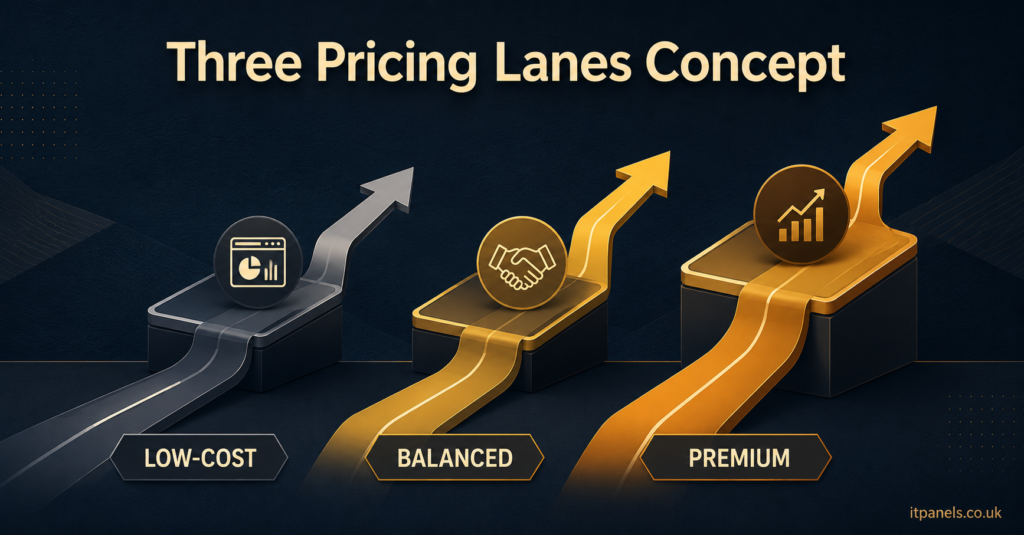
Pro tip: Pick one lane before you launch a pricing page. Trying to be the cheapest and the most attentive at the same time usually means quietly failing at both.
Reading Competitor Pricing Without Copying It
Checking what other UK resellers charge is sensible groundwork, but treating a competitor’s headline price as your target is a common trap. A rival advertising a low monthly rate might be running at a loss to build a customer base quickly, or bundling in far less support than you’re planning to offer. Copying the number without copying the business behind it just imports someone else’s economics into your pricing.
A more useful exercise is working backwards from your own credit cost. Reviewing current IPTV Reseller Panel Prices UK figures gives you a realistic floor for what a subscriber month actually costs you to deliver, and your subscriber price needs to sit meaningfully above that floor once support time and refunds are accounted for, not just above the raw credit cost.
IPTV Reseller Pricing Strategy UK Built Around Renewals, Not Just Sign-Ups
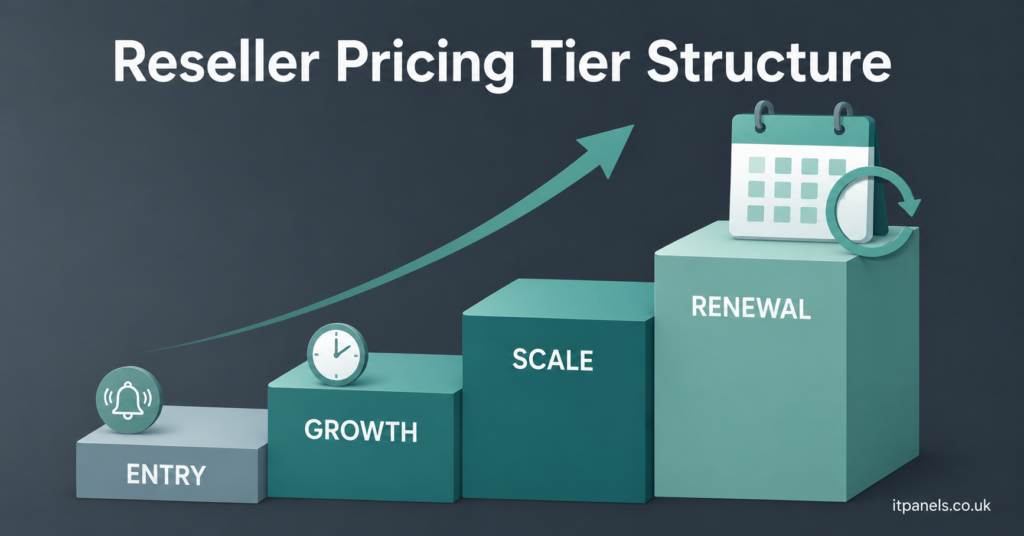
New resellers tend to price for the first sale. A genuinely useful IPTV Reseller Pricing Strategy UK has to price for the twelfth renewal instead, because that’s where the actual business lives. A customer who signs up once and cancels after a buffering issue has cost you acquisition effort for nothing, while a customer who renews quietly for two years at a slightly lower monthly rate is worth considerably more over time.
This changes how discounting should work. Offering a steep first month discount to win the sign up, then jumping straight to full price, tends to produce exactly the cancellation spike you’d expect. A gentler structure, where longer commitments earn a modest and permanent discount rather than a short introductory one, rewards the behaviour you actually want, which is customers staying rather than customers signing up.
Pro tip: If you offer a discounted first month, tell the customer clearly what the second month will cost before they pay. Surprise price jumps generate far more support tickets than the discount was worth.
When and How to Raise Prices Without Losing Subscribers
Almost every reseller eventually needs to raise prices, whether because credit costs shift or because the business has simply grown past its original numbers. The mistake is treating this as a single announcement rather than a process. Raising prices for new customers only, while leaving existing subscribers on their original rate for a defined period, tends to cause far less friction than an across the board increase applied overnight.
Giving genuine notice matters too. A price change that appears on the next invoice with no warning reads as underhand, even when the increase itself is reasonable. Two to four weeks’ notice, explained plainly, gives customers time to adjust their expectations rather than feeling ambushed.
It also helps to separate the reasons a price rise is happening from the reasons a customer should care. Explaining that your own credit costs went up is your problem, not theirs. Framing the change around what they continue to get, whether that’s faster support or a wider device compatibility, keeps the conversation focused on value rather than justification.
Common Pricing Mistakes That Quietly Cap Growth
A handful of patterns show up repeatedly among UK resellers whose pricing never quite settles into something sustainable. Changing prices too often is one of them, since customers start to distrust a rate that moves every few months, even if each individual change is small and reasonable. Offering unlimited custom pricing to anyone who asks is another, because it erodes the published rate card and makes every future negotiation harder to hold firm on.
Pricing every device and app combination identically is a subtler mistake. Some setups genuinely need more support time than others, and folding that extra cost into a single flat rate for everyone means your least demanding customers are quietly subsidising your most demanding ones.
Anyone still working out the basics of credit costs before building pricing on top of them is generally better off reading through how IPTV Reseller Credits UK pricing actually works first, since a pricing strategy built on a misunderstanding of what a credit covers rarely holds up once real customers arrive.
Frequently asked questions
Should I charge the same price for every device or app a customer uses?
Not necessarily. If certain setups reliably need more support time or run into more compatibility issues, pricing them slightly higher reflects the real cost of serving that customer rather than spreading it across everyone else.
How many pricing tiers should a new reseller offer?
Two or three is usually enough to start. Too many tiers make the choice confusing for customers and make it harder for you to track which tier is actually profitable once support time is included.
Is it better to discount long-term subscriptions upfront?
A smaller, permanent discount for longer commitments tends to work better than a large short-term introductory offer, since it rewards the renewal behaviour that actually sustains the business.
Should sub reseller pricing be advertised publicly?
Many UK resellers keep sub reseller rates private and discuss them directly, since that tier usually depends on individual volume and support arrangements that don’t translate well to a public price list.
How often should pricing actually be reviewed?
Reviewing every few months against your own credit costs and support load is generally more useful than reacting immediately every time a competitor changes their rate.
Conclusion
An IPTV Reseller Panel Pricing Strategy UK that actually holds up comes from deciding early whether you’re competing on price, margin, or support, then building tiers, discounts, and any future rate rises around that single decision rather than reacting to whatever a competitor does next. Pricing for renewals rather than first sign ups, giving genuine notice before any increase, and reviewing your numbers on a regular schedule will do more for long-term stability than chasing the lowest headline price in the market. Checking your current IPTV reseller plans against these principles is a reasonable next step before adjusting anything.
Pricing Strategy Checklist
- Decide whether you’re competing on price, margin, or support before setting a single number
- Price meaningfully above your actual credit cost, not just above the headline rate
- Reward long-term commitment with a permanent discount rather than a steep introductory offer
- Give existing customers real notice before any price increase takes effect
- Avoid pricing every device or app setup identically if support time genuinely differs
- Review pricing on a set schedule rather than reacting to competitors in real time
