

IPTV Reseller vs Sub Reseller: Key Differences 2026

IPTV Reseller vs Sub Reseller comes down to one question that decides almost everything else: whose panel do you actually control? A full reseller buys credits straight from the panel provider and owns that relationship directly. A sub-reseller operates underneath someone else’s reseller account, using credits and permissions that person chooses to hand over. Everything from pricing freedom to what happens if things go wrong flows from that one structural difference.
IPTV Reseller vs Sub Reseller: What Each Role Actually Means
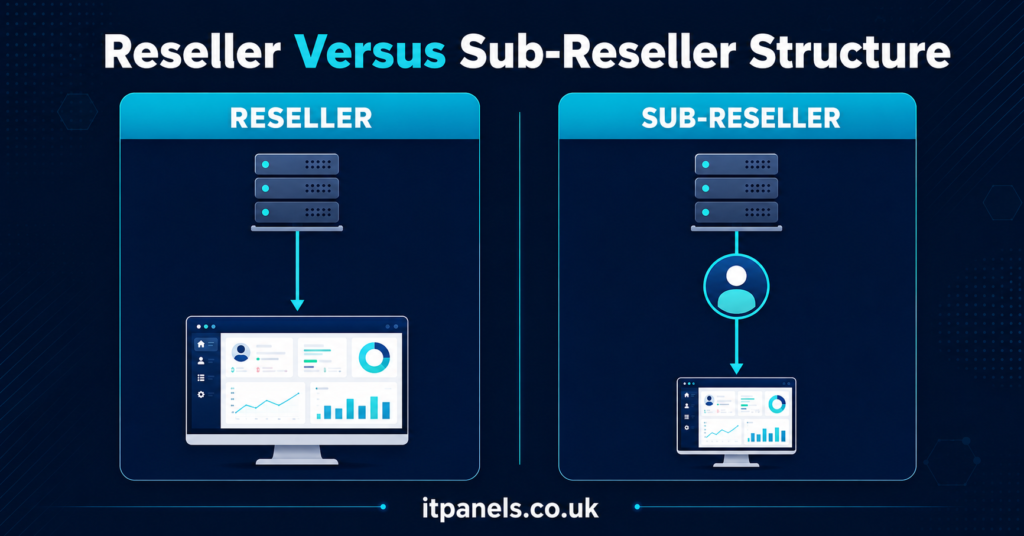
A IPTV reseller Panel account sits directly under the panel provider. You purchase credits in your own name, log into your own dashboard, and answer to nobody but the provider you bought from. If the provider updates their terms, changes pricing, or has a technical issue, you deal with it as a direct customer.
A sub-reseller account sits one layer further down. Someone who is already a full reseller creates a smaller account inside their own panel and allocates you a slice of their credit pool, along with a set of permissions they define. You are not buying from the original provider at all. You are buying from, and answerable to, the reseller above you.
This is not a difference in scale. A sub-reseller with hundreds of customers is still structurally a sub-reseller, and a reseller with a handful of clients is still a full reseller. The distinction is about who sits between you and the underlying panel, not how big your operation has grown.
Where the Credits Actually Come From
Credits are the currency of the whole business, so it matters who controls the tap. A full reseller buys a credit package directly and that balance belongs to them outright, with no intermediary able to touch it. A sub-reseller draws from an allocation that the parent reseller assigns, and that allocation can be adjusted, paused, or withdrawn depending on the parent account’s own arrangement with the provider.
This has a practical consequence that new sub-resellers sometimes miss. If your parent reseller runs low on credits, has a payment dispute with the provider, or simply decides to restructure their business, your own supply can be affected even though you did nothing wrong. A full reseller does not carry that particular exposure, because there is no middle layer between them and the source.
Dashboard Permissions and What You Can Actually Change
A full reseller’s dashboard is theirs to configure. Branding, line duration limits, trial policies, and customer management tools are all set by the account holder, because there is no one above them to restrict those choices.
A sub-reseller’s dashboard is a scoped view into someone else’s system. The parent reseller decides which functions are switched on. Some parent accounts hand over almost everything short of billing access. Others keep sub-resellers to a narrow set of actions, such as creating and renewing lines, while withholding anything that touches pricing structure or bulk account changes. Before agreeing to a sub-reseller arrangement, it is worth asking exactly what the dashboard will and will not let you do, rather than assuming it mirrors a full account.
Pro tip: Ask to see the actual sub-reseller dashboard before paying, not just a description of it. What a permission set looks like on screen often differs from how it is described in a sales message.
Who Carries the Support and Risk
Support responsibility splits along the same line as everything else. A full reseller deals directly with the provider’s support channel when something technical goes wrong, and the provider is contractually the party responsible for resolving it.
A sub-reseller typically raises issues with their parent reseller first, who then either resolves it themselves or escalates to the provider. That extra step can mean slower resolution during busy periods, particularly if the parent reseller is managing many sub-accounts at once. It also means your customer’s experience depends partly on how responsive your parent reseller is, which is a variable you cannot fully control once you have chosen that route.
Risk works the same way in reverse. If a provider closes down or changes its offering unexpectedly, a full reseller feels that impact directly and can shop around for a new provider on their own terms. A sub-reseller feels it only after it has already passed through the parent reseller, and how that gets communicated, and how fairly any remaining credits are handled, is entirely down to the parent’s own conduct.
Margins and Why They Differ
A full reseller buys credits at the provider’s stated rate and sets retail prices with no one else taking a cut in between. A sub-reseller usually buys at a rate the parent reseller sets, which sits above the parent’s own cost, so there is an additional margin layered into the chain before it ever reaches the sub-reseller’s own customers.
This does not automatically make sub-reselling a poor choice. For someone starting out with a small customer base and no interest in managing bulk credit purchases, a slightly thinner margin can be a fair trade for a lower barrier to entry and someone else handling the underlying account relationship.
When a Sub-Reseller Setup Makes Sense
A sub-reseller arrangement tends to suit people who want to test the business without committing to a large upfront credit purchase, who would rather rely on an established reseller’s infrastructure and reputation than build their own from scratch, or who are managing a modest number of customers and do not yet need full account control.
It can also work well for someone who already has a customer base through another line of work, such as running an electronics shop or a local IT support service, and wants to add IPTV subscriptions as a side offering without taking on a second full business relationship with a provider.
When You Are Better Off as a Full Reseller
A full IPTV Panel reseller account fits better once pricing control, dashboard access, and direct provider support genuinely matter to how you operate. If you are managing a growing customer base, need branding consistency you control end to end, or want the certainty that your credit supply cannot be affected by someone else’s account decisions, going direct removes that layer of dependency entirely.
Cost also plays a role, but not in the way people sometimes assume. Buying credits directly is not automatically more expensive than sub-reselling once volume increases, because the margin a parent reseller builds into sub-reseller pricing tends to matter more as your customer numbers grow.
Pro tip: Track how much of your monthly credit spend is going toward margin you could avoid by moving to a direct reseller account. If that figure keeps climbing, it is usually a sign you have outgrown the sub-reseller stage.
Signs You Have Outgrown a Sub-Reseller Account
A few patterns tend to show up when a sub-reseller has reached the point of needing a direct account. Customer numbers have grown to where the margin difference is noticeable every month. Support requests are taking longer to resolve because they pass through an extra layer. The parent reseller has started restricting permissions or changing terms without much notice. Or there is simply a desire to build a brand and customer relationship that does not depend on someone else’s account staying active.
None of these signs on their own means a change is urgent, but two or three appearing together is usually a reasonable trigger to look at what a direct reseller account, such as those offered through itpanels.co.uk, would involve in terms of setup and credit packages.
Questions to Ask Before You Commit to Either Model
Before signing up as a sub-reseller, it is worth asking the parent reseller directly what happens to your credits and customers if their own account is ever suspended or closed. Ask whether pricing is fixed or can change without notice, and whether you would be told in advance. Ask what level of dashboard access you will actually receive, in writing if possible, rather than relying on a verbal description.
Before setting up as a full reseller, it is worth being honest about whether you have the customer volume and time to manage a direct provider relationship, including handling your own support escalations and credit purchasing decisions without someone else absorbing that workload for you.
IPTV Reseller vs Sub Reseller: Frequently Asked Questions
Can a sub-reseller become a full reseller later?
Yes, in most setups a sub-reseller can move to a direct reseller account with a provider at any point, though existing customer lines may need to be migrated rather than transferred automatically.
Does a sub-reseller get their own branded dashboard?
This depends entirely on the parent reseller’s setup. Some sub-reseller accounts include basic branding options, while others provide only a functional login with no customisation.
Who is responsible if a sub-reseller’s customer has a streaming issue?
The sub-reseller usually handles the first point of contact with their customer, then escalates to the parent reseller if the issue cannot be resolved at their permission level.
Is it cheaper to start as a sub-reseller than a full reseller?
Starting costs are often lower for a sub-reseller because there is typically no need to buy a large credit package upfront, though the per-credit cost can end up higher over time.
What happens to sub-reseller customers if the parent reseller stops trading?
This depends on the parent reseller’s own arrangement with the provider. It is a genuine risk worth asking about directly before committing, since there is no guaranteed continuity built into every setup.
Can a sub-reseller set their own retail prices?
Some can, within limits set by the parent reseller. Others are given a fixed pricing structure they must follow, so this is worth confirming before agreeing to the account.
Reseller vs Sub-Reseller Decision Checklist
- Confirm whether you would be buying credits directly or through a parent reseller’s allocation
- Ask exactly which dashboard permissions come with the account before paying
- Find out what happens to your credits and customers if the account above you changes or closes
- Compare the effective per-credit cost against a direct reseller package at your expected volume
- Check who you would actually contact for support and how quickly they typically respond
- Decide whether long-term brand ownership matters enough to justify starting with a full reseller account instead
Conclusion
IPTV Reseller vs Sub Reseller is ultimately a question of how much control and direct responsibility you want from day one. A sub-reseller account offers a lower barrier to entry and someone else managing the underlying provider relationship, at the cost of thinner margins and less control over pricing and permissions. A full IPTV Panel reseller account puts you in direct contact with the provider, with full dashboard control and no intermediary risk, but it asks more of you in terms of upfront commitment and ongoing account management. Match the choice to where your customer base and ambitions actually sit today, not where you hope they will be in a year, and revisit the decision once your volume or your patience with someone else’s permissions starts to change.

[…] opposite mistake happens too. Some new resellers buy a large pack before confirming their IPTV Reseller panel features actually suit how they intend to sell, then discover the dashboard, app compatibility or […]